Blogs
Solo FDE vs. Working on an FDE Team: Pros and Cons
Solo FDE vs. Working on an FDE Team: Pros and Cons
By
R&D, FDE Academy
September 11, 2026

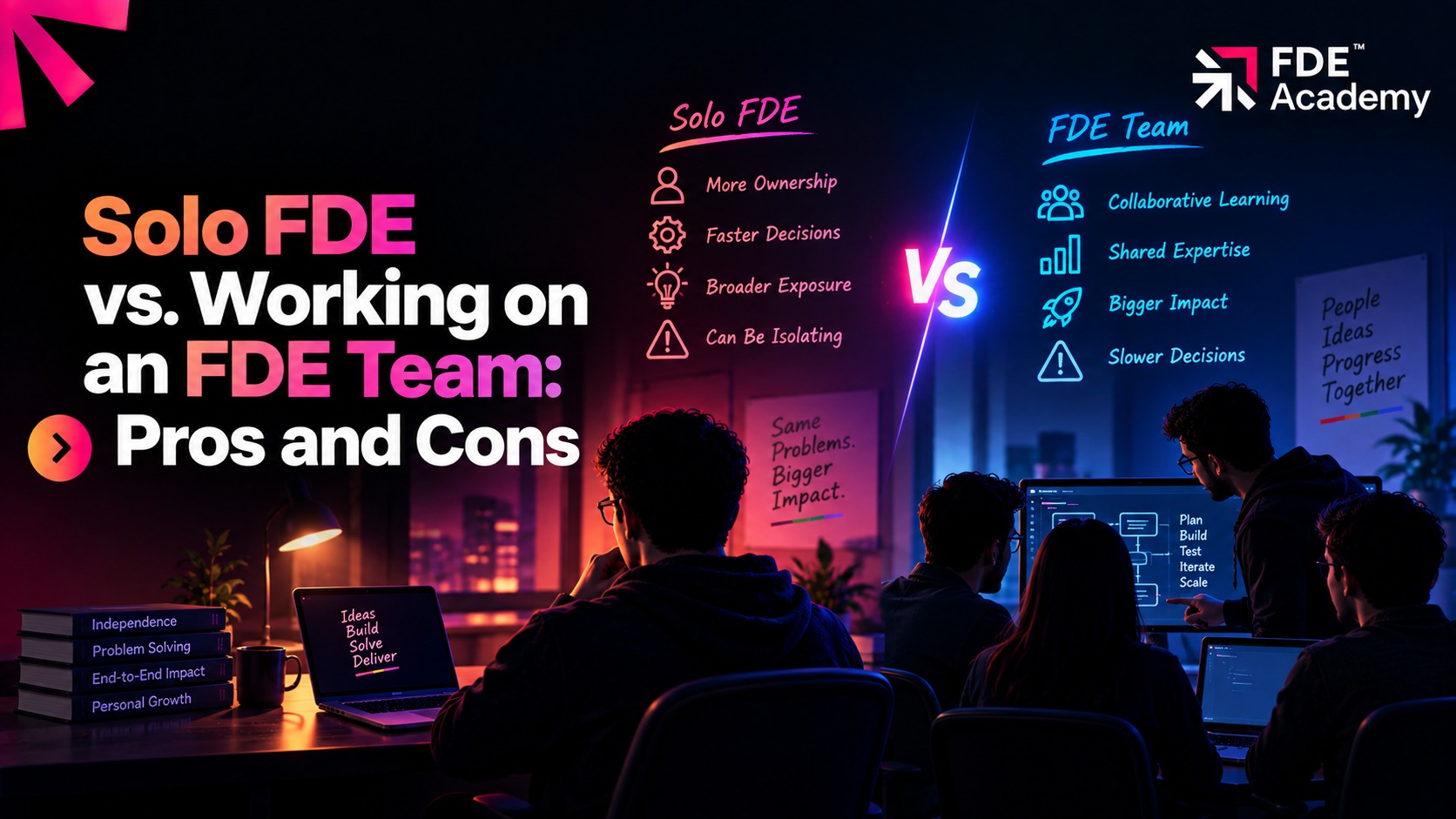
TL;DR: The same job title can mean two very different day-to-day jobs depending on staffing model. As a solo FDE, you own an account end to end full autonomy, but also the full weight of every technical, product, and relationship problem that comes up, with no one else to catch what you miss.
On an FDE team or pod, you get specialist support, shared context, and coverage when you're out but less individual ownership and more coordination overhead. Neither is objectively better; the right fit depends on your experience level, tolerance for isolation, and what kind of growth you're optimizing for.
Two people can hold the exact same "Forward Deployed Engineer" title at two different companies and have almost nothing in common in their actual day-to-day experience, because staffing structure, solo placement versus team-based pod changes nearly everything about how the job actually feels.
FDE team structures typically fall into one of two patterns: one FDE per strategic account, or a pod model combining an FDE with a product manager and a data engineer, and which pattern you land in shapes your workload, your growth curve, and your risk exposure far more than the title itself does.
This is also a genuinely live industry debate, not just an individual career question. Leading organizations are increasingly moving away from the "lone wolf" FDE model, instead embedding cross-functional AI delivery PODs that integrate engineering, domain expertise, and governance a structural shift worth understanding if you're evaluating an offer, since it tells you something about how seriously a company has thought through its FDE function. For the foundational role definition this comparison builds on, see our guide to Forward Deployed Engineer.
As a solo FDE, you're typically the only technical person embedded at a given customer account, responsible for discovery, architecture, implementation, and the ongoing relationship start to finish. Solo engineer placements work best for focused projects with clear scope, functioning as either a single-use-case build or technical augmentation of an existing customer team.
The appeal is real: maximum autonomy, direct and unfiltered customer relationships, and a level of end-to-end ownership that accelerates learning faster than almost any other early-career engineering structure. You make the calls, you see the consequences immediately, and there's no ambiguity about whose work delivered the outcome.
The cost is equally real, and it's structural, not just a matter of individual toughness. A solo engineer often ends up spending their time on fragmented data fixes rather than architecting a cohesive, production-grade environment, simply because there's no one else to take on the unglamorous, unscoped work that piles up around any real deployment.
Without a second technical perspective in the room, you're also more exposed to scope creep and accumulating tech debt, a well-documented failure pattern in FDE work generally, and one solo placements are particularly vulnerable to since there's no teammate to flag it before it compounds.
On a pod-structured team, you share the account with specialists, commonly a product manager and a data engineer alongside the FDE, sometimes more depending on account size. A POD is designed to architect a cohesive, production-grade environment, with reusable architecture connectors, guardrails, governance frameworks meaning each subsequent use case deploys faster than the one before it, rather than each engagement starting from a blank slate the way a solo placement often does.
This structure trades some individual ownership for real, compounding advantages. Well-run FDE functions staff lean pods reporting into product or engineering, running a disciplined lifecycle from discovery through prototype, deploy, productize, and eventually scaling back to the core product team a level of process discipline that's genuinely hard for a solo engineer to maintain alone while also carrying full delivery responsibility.
Coverage is also a real, practical benefit: when you're out sick, on vacation, or simply stuck on a hard problem, a pod has someone who already has context and can step in, where a solo placement often just... stalls.
The trade-off is real too: less individual autonomy, more time spent on internal coordination and handoffs, and a diluted, less direct version of the customer relationship that made solo FDE work appealing to many people in the first place.
Solo FDE work carries specific, well-documented risks worth taking seriously before accepting a solo placement. Large organizations lose an average of $47 million a year in productivity to inefficient knowledge sharing, with knowledge workers spending 5.3 hours a week recreating undocumented institutional knowledge a cost that concentrates heavily around solo, single-point-of-failure engineering placements specifically, since there's no one else who holds the context if you leave, get sick, or simply need a break.
This is sometimes called the "bus factor" problem, and it's one of the clearest structural risks of solo FDE work: a failure signal worth watching for is when a handover is documented rather than demonstrated, since documentation alone rarely captures the messy, tacit knowledge a solo engineer accumulates about one account over months.
Our broader look at the biggest risks Forward Deployed Engineers face covers burnout and isolation risk in more depth both of which apply to FDE work generally but hit solo placements hardest, given the lack of a built-in peer support structure that a pod naturally provides.
Team-based pods aren't risk-free either, though the risks are different in kind. The core distinction between staff augmentation and a true embedded pod is accountability, not team composition; a pod that owns the outcome contractually behaves very differently from one that's simply supplying headcount without real ownership.
A poorly structured pod can end up with diffused accountability, where everyone assumes someone else is watching the ball, a coordination failure solo placements are structurally immune to, precisely because there's no one else to defer to.
Staffing structure correlates strongly with company stage and maturity, which is worth knowing before you evaluate an offer. Earlier-stage AI startups more often default to solo placements simply because headcount is scarce and the FDE function itself is still being figured out. Our comparison of AI startup vs enterprise Forward Deployed Engineer roles covers this broader pattern in depth.
Larger, more mature AI companies increasingly default to pod structures instead: AWS's $1 billion investment to embed thousands of forward-deployed engineers inside customer organizations reflects the industry's move toward embedded engineering at scale, co-developing production agentic systems under the customer's real constraints with self-sufficiency as the explicit goal a scale of investment that only makes sense with real team structure behind it, not isolated solo placements.
This means the "solo vs team" question isn't purely a personal preference decision it's also a signal about where a given company is in its own FDE maturity, and worth asking about directly in an interview rather than assuming.
The staffing model doesn't just change your day-to-day workload it changes how the actual delivery lifecycle runs. Our guide to the FDE project lifecycle from discovery to deployment maps the phases every FDE engagement moves through; a solo FDE typically owns every phase personally, while a pod distributes phases across specialists often with the FDE leading discovery and prototype while a data engineer owns pipeline work and a PM manages the productization handoff.
One of the phases that most often constrains the whole model is the one that can't be scaled through more process: customer discovery, since a 2–3 person function hits the limit of one engineer's conversation capacity fairly fast a useful reminder that even pod structures have real limits, and that adding headcount doesn't automatically solve every bottleneck in FDE delivery.
If you're earlier in your FDE career, a pod structure is generally the safer, faster path to building real skill you get to observe how experienced specialists handle the parts of the job you haven't mastered yet, with real coverage if you get stuck. Our guide to the habits of successful Forward Deployed Engineers points to consistent peer calibration as a recurring trait among strong performers, which a pod structure provides naturally and a solo placement doesn't.
If you're an experienced engineer who thrives on full autonomy and direct, unmediated customer relationships, a well-scoped solo placement can be genuinely rewarding provided the engagement itself is focused enough to avoid the scope-creep trap, and provided you go in with eyes open about the isolation and bus-factor risk.
Companies that have thought seriously about structuring their FDE function well worth checking against the Forward Deployed Engineer playbook are increasingly choosing pods even for what looks like a single-account engagement, which is itself useful diligence to do before accepting a solo offer.
Yes, in specific, well-documented ways primarily bus-factor risk (no one else holds context if you're out or leave), higher exposure to scope creep and accumulating tech debt, and burnout risk from carrying full account ownership without built-in peer support or coverage.
An FDE pod is a team-based staffing structure that pairs a Forward Deployed Engineer with specialists like a product manager and a data engineer, sharing ownership of discovery, delivery, and the customer relationship rather than placing one engineer alone on an account.
Not strictly, but there's a strong correlation. Earlier-stage AI startups more often default to solo placements due to limited headcount, while larger, more mature companies increasingly structure their FDE function around pods, particularly for complex, multi-workstream enterprise engagements.
A pod structure is generally the safer choice for engineers earlier in their FDE career, since it provides built-in peer support, coverage, and the chance to observe experienced specialists handle parts of the job a solo placement would force you to learn without a safety net.
There's no consistent industry-wide pattern showing solo placements pay more. Compensation depends far more on company, level, and account complexity than on staffing structure alone; it's worth asking directly rather than assuming either structure pays a premium.
The world is hiring - and this Academy prepares you for it.