Blogs
Which Industries Need Forward Deployed Engineers the Most? (2026 Guide)
Which Industries Need Forward Deployed Engineers the Most? (2026 Guide)
By
R&D, FDE Academy
August 18, 2026

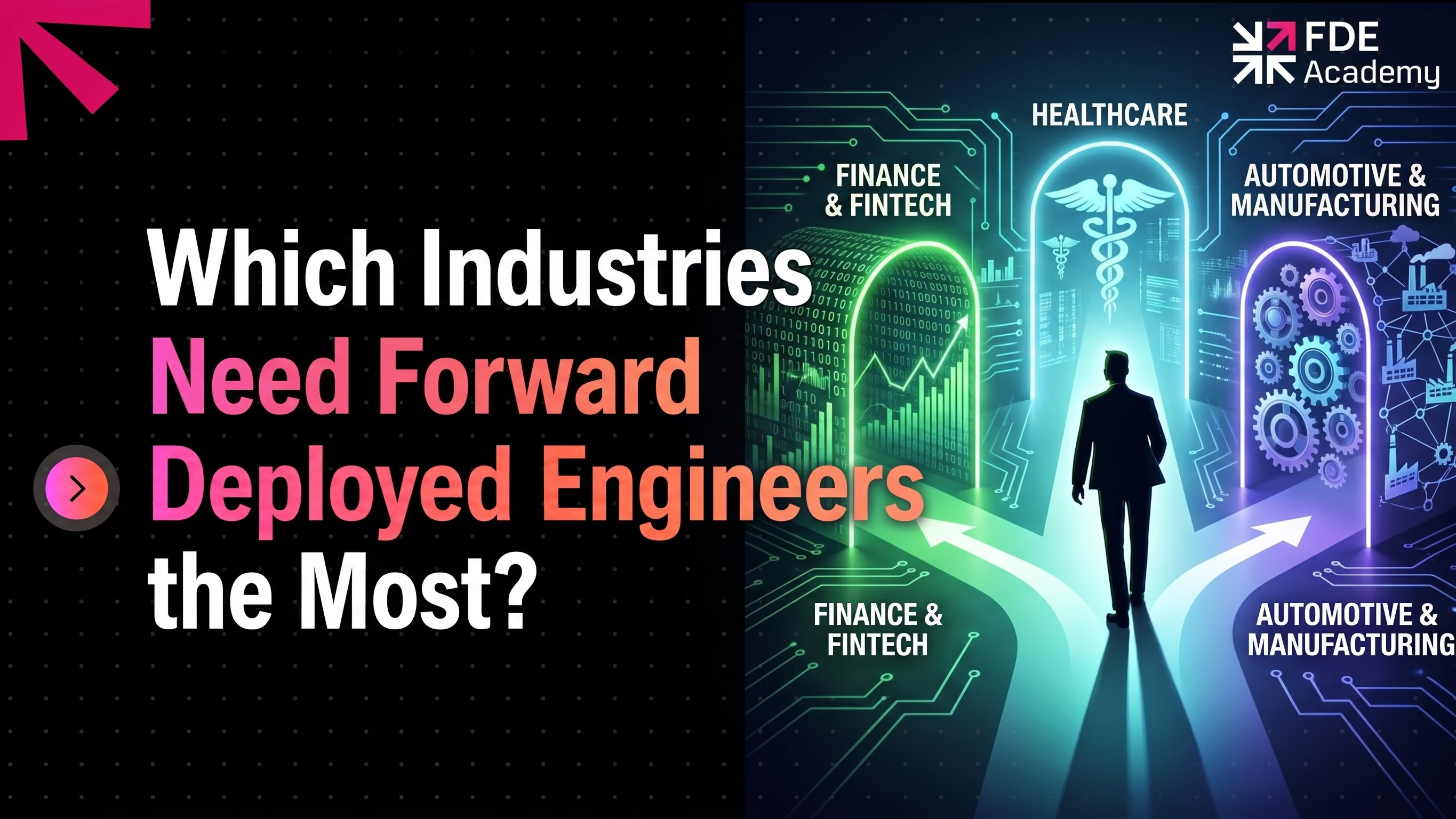
Not every company that adopts AI needs a forward deployed engineer but certain industries can barely scale AI without one.
The difference usually comes down to three things: how regulated the environment is, how fragmented the underlying systems are, and how much a single wrong decision could cost. Industries where all three run high are exactly where forward deployed engineers (FDEs) have become indispensable rather than optional.
Three structural traits predict whether an industry leans on forward deployed engineers rather than off-the-shelf automation. First, regulatory density: industries with strict compliance requirements need AI systems built with audit trails, human-in-the-loop checkpoints, and governance logic specific to their jurisdiction.
Second, legacy system fragmentation: industries running on decades-old core systems need engineers who can integrate AI safely without ripping out infrastructure the business depends on.
Third, decision stakes: when an AI-driven mistake could cost real money, safety, or legal exposure, organizations want an engineer who understands their specific context, not a generic tool configured by someone who's never seen their data.
Industries that score high on all three consistently show up at the top of FDE demand and it's rarely a coincidence that these are also the industries spending the most on enterprise AI overall. It's worth noting that these traits tend to reinforce each other rather than operate independently.
A heavily regulated industry is also more likely to be running on older, harder-to-replace core systems, simply because regulatory approval cycles slow down infrastructure modernization. That compounding effect is a big part of why FDE demand clusters so tightly around a relatively small set of sectors instead of spreading evenly across the economy.
It's tempting to assume that company size drives forward deployed engineers' demand for a bigger company, bigger budget, more FDEs. But industry characteristics matter more than headcount.
A mid-sized regional bank with a compliance-heavy, systems-fragmented environment often needs more embedded engineering support than a much larger consumer tech company with a clean, modern stack and low regulatory burden.
This is why forward deployed engineering demand clusters so tightly around specific sectors rather than spreading evenly across company size.
Financial services consistently leads enterprise AI spending, and much of that investment goes toward fraud detection, algorithmic trading systems, and customer-facing service automation all of which require tight integration with legacy core banking systems and strict regulatory oversight.
This combination of scale, regulation, and legacy infrastructure is exactly why companies are hiring forward deployed engineers in this sector at a faster rate than almost anywhere else. Banks in particular face a unique constraint: their core systems often predate modern APIs entirely, meaning an FDE's job frequently starts with building safe, auditable bridges between AI models and infrastructure that was never designed to talk to them.
Healthcare organizations are adopting AI quickly for clinical decision support, medical imaging analysis, and administrative automation, but clinical workflows move slower than other use cases because of regulatory complexity and patient-safety stakes.
FDEs bridge that gap by building automation that respects compliance requirements while still integrating with electronic health record systems and hospital-specific workflows that no generic healthcare AI product fully anticipates.
The stakes here are also different in kind, not just degree a misconfigured automation in a hospital billing workflow is an inconvenience, but the same kind of gap in a clinical decision-support tool carries real patient risk, which is why so much of this work depends on engineers who can sit with clinical and compliance teams directly rather than working from a spec document alone.
Manufacturing's AI spending is concentrated in predictive maintenance and quality control, both of which depend on connecting AI systems to real-time sensor data, ERP platforms, and plant-floor infrastructure that varies enormously from one facility to the next.
This is inherently a systems-integration problem before it's an AI problem, which is precisely the kind of work forward deployed engineers are built for.
No two factories run identical equipment configurations, which means a predictive-maintenance model that works at one plant often needs meaningful rework before it performs reliably at another, exactly the kind of on-the-ground adaptation a generic software vendor can't provide at scale.
Insurance carriers face many of the same regulatory pressures as banking, plus the added complexity of claims workflows that vary by policy type, state, and line of business.
Automating underwriting or claims triage without an engineer who understands these specific rules tends to produce automation that either over-flags everything for human review or, worse, makes decisions the compliance team can't explain later.
Government and defense organizations operate under security and procurement constraints that most commercial AI products aren't built to meet.
Mission-specific data analysis and decision-support systems in this space almost always require custom engineering rather than a configured SaaS product, making it one of the more consistent sources of forward deployed engineering demand even though it moves more slowly than the private sector.
Procurement cycles in this space are also longer and more document-heavy than in commercial industries, which means FDEs working in government contexts often need as much comfort with compliance documentation and security clearance processes as they do with the underlying AI systems themselves.
Technology companies show the highest overall AI adoption rates, but their forward deployed engineer demand comes from a different direction: large B2B SaaS vendors embed FDEs directly with major enterprise customers to handle custom onboarding, data migration, and integration work that a standard implementation team can't scale to.
This is a major part of the benefits of hiring forward deployed engineers for enterprise AI that many SaaS companies now build entire go-to-market motions around.
Not every sector needs this model, and that's worth saying plainly. Media and publishing, consumer apps, early-stage retail and e-commerce, and education technology tend to have lighter compliance burdens, more standardized workflows, and less legacy-system complexity which means off-the-shelf AI tools usually deliver strong results without the cost of embedded engineering talent.
Education specifically lags most other sectors in AI adoption overall, largely due to budget constraints rather than a lack of use cases, which further reduces near-term FDE demand there.
None of this means AI doesn't matter in these industries, it just means the "buy and configure" model tends to outperform the "build with an embedded engineer" model when regulatory and integration complexity are both low.
A consumer app with a modern, single-stack architecture simply doesn't generate the kind of integration and governance work that justifies dedicated forward deployed engineering time.
Across the high-demand sectors above, a consistent pattern emerges. According to NVIDIA's 2026 State of AI report, financial services, retail and CPG, and healthcare and life sciences showed the strongest adoption and ROI results across the industries surveyed and these are the same sectors where embedded engineering talent tends to concentrate, because ROI depends on the automation actually working inside a messy, specific environment rather than a clean demo.
Deloitte's 2026 State of AI in the Enterprise research similarly found that most organizations now expect to customize their AI agents to fit specific business needs rather than deploy generic tools unchanged and customization at this level is exactly the work forward deployed engineers are hired to do.
In practice, that means FDEs in these industries spend less time writing net-new AI logic and more time on data pipeline reliability, compliance-aware workflow design, and integration with systems that were never built with AI in mind.
For companies in high-demand industries, the takeaway is straightforward: budget for embedded engineering talent earlier rather than assuming a generic AI tool will scale past the pilot stage. Trying to force a regulated, systems-heavy workflow into an off-the-shelf product usually ends in a stalled project, not a shortcut.
For engineers considering this career path, industry choice matters as much as company choice. Financial services, healthcare, insurance, and public sector roles tend to offer steadier long-term demand precisely because the underlying complexity that creates FDE roles in the first place regulation, legacy systems, high stakes isn't going away anytime soon, even as AI tooling itself keeps improving.
This is also a big part of why forward deployed engineers are in high demand across these sectors specifically, rather than uniformly across the whole economy.
As AI vendors build more industry-specific products, some of today's FDE work will eventually shift toward configuration rather than custom engineering the same way generic automation tools slowly absorbed simpler use cases over the past decade.
But the core industries driving demand today share structural traits, regulation, legacy fragmentation, and high stakes that don't disappear just because tooling improves. If anything, as AI systems take on more autonomous, multi-step decision-making, the industries that already require the most oversight will likely need even more embedded engineering judgment to deploy that autonomy safely, not less.
Financial services, healthcare, insurance, manufacturing, and public sector organizations need forward deployed engineers the most, because they combine heavy regulation, fragmented legacy systems, and high-stakes decision-making that generic AI tools can't safely handle.
Technology and B2B SaaS companies also rely on FDEs heavily, but for a different reason embedding engineers with major enterprise customers to customize deployments at scale.
Lower-complexity, less-regulated industries like media, basic retail, and early-stage consumer apps typically get more value from off-the-shelf AI tools than from dedicated forward deployed engineering talent.
The industries below aren't guessed; they're the sectors where AI spending, regulatory complexity, and legacy-system sprawl consistently overlap, which is exactly the combination that makes embedded, client-specific engineering worth the investment.
Understanding this pattern matters whether you're a company deciding how to staff your next AI initiative, or an engineer deciding which industry to build a career around.
Financial services, healthcare, insurance, manufacturing, and public sector organizations show the strongest demand, driven by regulatory complexity, legacy system fragmentation, and high-stakes decision-making.
Banking and financial services combine large AI budgets with strict regulation and decades-old core systems, all of which require engineers who can integrate AI safely into that specific environment.
Yes, but differently B2B SaaS and enterprise tech companies use FDEs to embed with large customers and handle custom onboarding, integration, and data migration at scale.
Media, consumer apps, early-stage retail, and education technology generally see less demand, since lighter regulation and simpler systems make off-the-shelf AI tools sufficient.
Some simpler use cases will shift toward configurable tools over time, but industries with heavy regulation and legacy complexity are likely to keep needing embedded engineering talent for the foreseeable future.
The world is hiring - and this Academy prepares you for it.