Blogs
Why Every AI Startup Needs a Forward Deployed Engineer (FDE)
Why Every AI Startup Needs a Forward Deployed Engineer (FDE)
By
R&D, FDE Academy
July 18, 2026

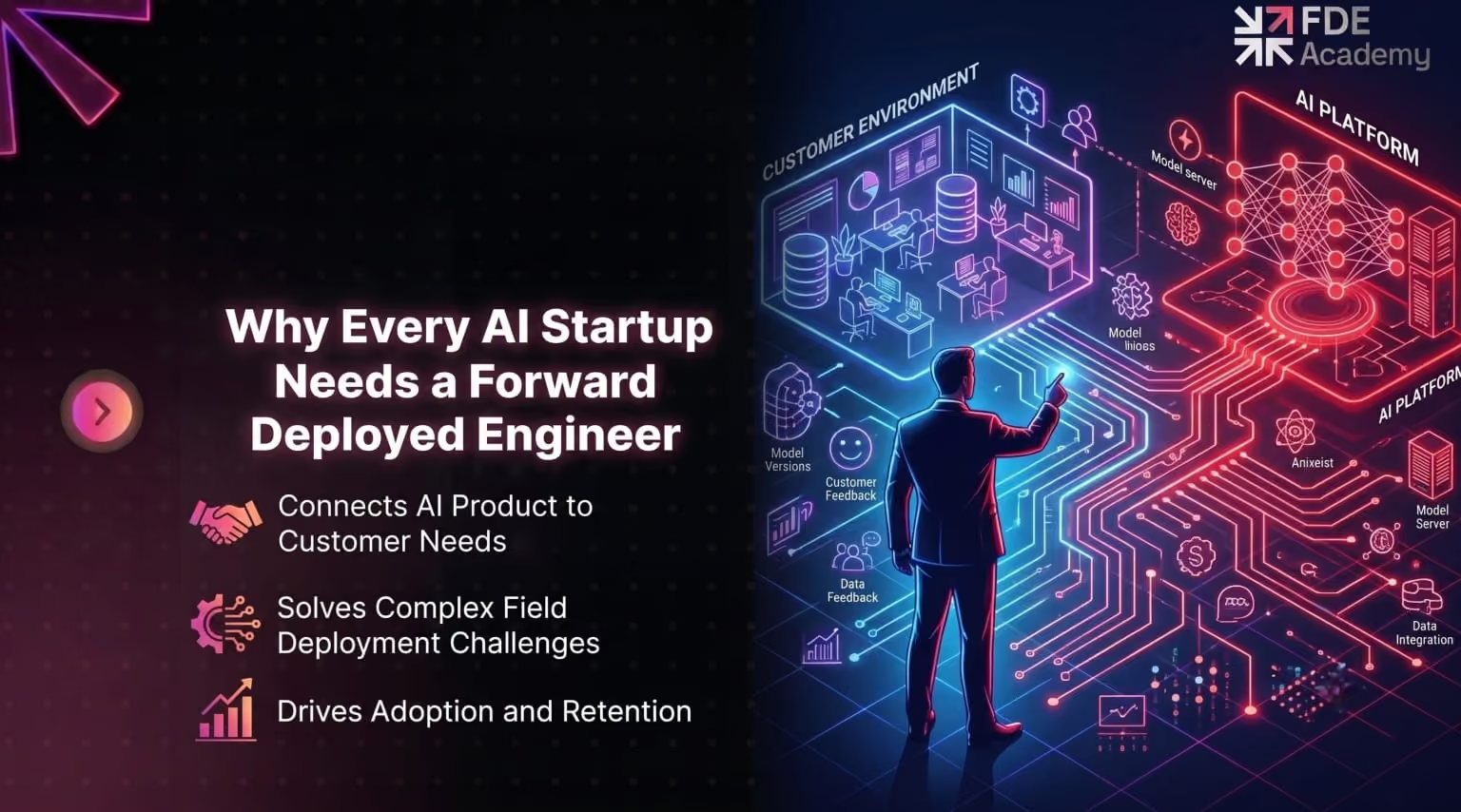
An AI startup's product almost never fails in the demo. It fails three weeks into a pilot, when the customer's real data doesn't match the clean examples the model was tuned on, when the integration hits a legacy system nobody documented, or when the customer's team simply never adopts the tool because nobody translated their actual workflow into the technical build.
A Forward Deployed Engineer exists specifically to own that gap, the distance between "the model works" and "the customer's business runs on it."
Not every startup needs one on day one. But the moment an AI startup signs its first serious enterprise customer, and discovers that closing the deal was the easy part, the case for this specific hire becomes obvious fast. This guide covers exactly what breaks without an FDE, what the role fixes, and how to know if your startup needs one now or can wait.
Every AI startup founder eventually hits the same wall. The product demos beautifully on curated examples. The pilot gets signed. Then the customer's actual data shows up, inconsistent formatting, missing fields, edge cases nobody anticipated, and the model's performance drops in ways that never showed up in testing. Or the integration turns out to require connecting to a fifteen-year-old internal system with no API and undocumented business logic. Or the model works fine technically, but the customer's team never actually adopts it, because nobody translated the customer's real workflow into what got built.
This is the single most common reason enterprise AI pilots stall or die: not because the underlying model is weak, but because nobody owned the gap between a working demo and a working deployment. Research on enterprise AI adoption consistently shows the majority of pilots never reach production, and the reason is almost never model quality, it's this exact deployment gap.
The pattern tends to repeat across a startup's early enterprise deals in a specific way. The first pilot goes reasonably well because it's small, low-stakes, and closely resembles the sales demo. The second pilot, often a larger, more strategic account, is where the gap actually shows up: more complex data, more entrenched legacy systems, more internal stakeholders who each have veto power over adoption. Founders who haven't seen this pattern before often assume something went wrong with the product itself, when the actual failure is structural, nobody on the team owns the specific job of making a working model survive contact with a specific customer's reality.
A startup's core engineering team is, correctly, focused on the product roadmap: making the model better, shipping features, scaling infrastructure for the next hundred customers. Asking that team to also own a specific enterprise customer's messy integration, sit in discovery calls, and debug production issues inside someone else's environment pulls them away from the work that actually scales the business, and it's a different skill set besides.
The skills that make someone a strong core product engineer, deep focus on one codebase, optimizing for many users at once, aren't the same skills that make someone effective embedded with one specific customer's chaos: rapid context-switching, discovery and requirements translation, comfort being the most senior technical person in a room full of non-technical stakeholders, and the judgment to scope a buildable solution from a vague, half-formed ask. A Forward Deployed Engineer is built specifically for that second skill set, not a weaker version of a product engineer, a different specialization entirely.
There's also a morale cost to pretending this isn't a specialization. Core engineers pulled into ad-hoc customer firefighting, without the discovery skills or customer-facing training an FDE role builds deliberately, tend to burn out on it fast, and understandably so, they signed up to build product, not to spend a week debugging why a customer's data warehouse rejects a specific field format. Treating deployment work as a real specialization, worth hiring for directly, protects both the roadmap and the team's morale at the same time.
Discovery that surfaces the real requirement, not the stated one. Customers rarely articulate what they actually need in the first conversation. An FDE runs structured discovery that uncovers the real workflow, the real data quality, and the real definition of success before a single line of customer-specific code gets written, catching the gap between what was pitched and what's actually needed before it becomes a production failure.
Integration work that doesn't fall on the core team. Connecting to a customer's legacy CRM, handling their specific authentication setup, working around a data warehouse nobody at your company has ever seen, this work is real, necessary, and completely different from building your product's next feature. An FDE absorbs it without derailing your core roadmap.
Evaluation rigor that catches failures before the customer does. A model that looks great on your test set can fail in specific, embarrassing ways against a customer's real data. An FDE builds evaluation harnesses tuned to that specific customer's use case, catching the failure modes that generic testing misses, before they show up in a production incident that damages the relationship.
A credible technical presence in the room during the deal that matters most. Enterprise buyers, especially technical ones, can tell the difference between a sales engineer running a polished demo and an engineer who can answer a hard technical question about their specific environment on the spot. An FDE in the room during a pivotal enterprise conversation changes how seriously a technical buyer takes the deal.
A feedback loop that actually improves the product. The patterns an FDE encounters repeatedly across customer deployments, the same integration challenge, the same data quality issue, the same missing feature, are exactly the signal a startup's product team needs to prioritize the roadmap correctly. Without someone embedded in real deployments, that signal gets lost or arrives filtered through a sales team that doesn't fully understand the technical nuance.
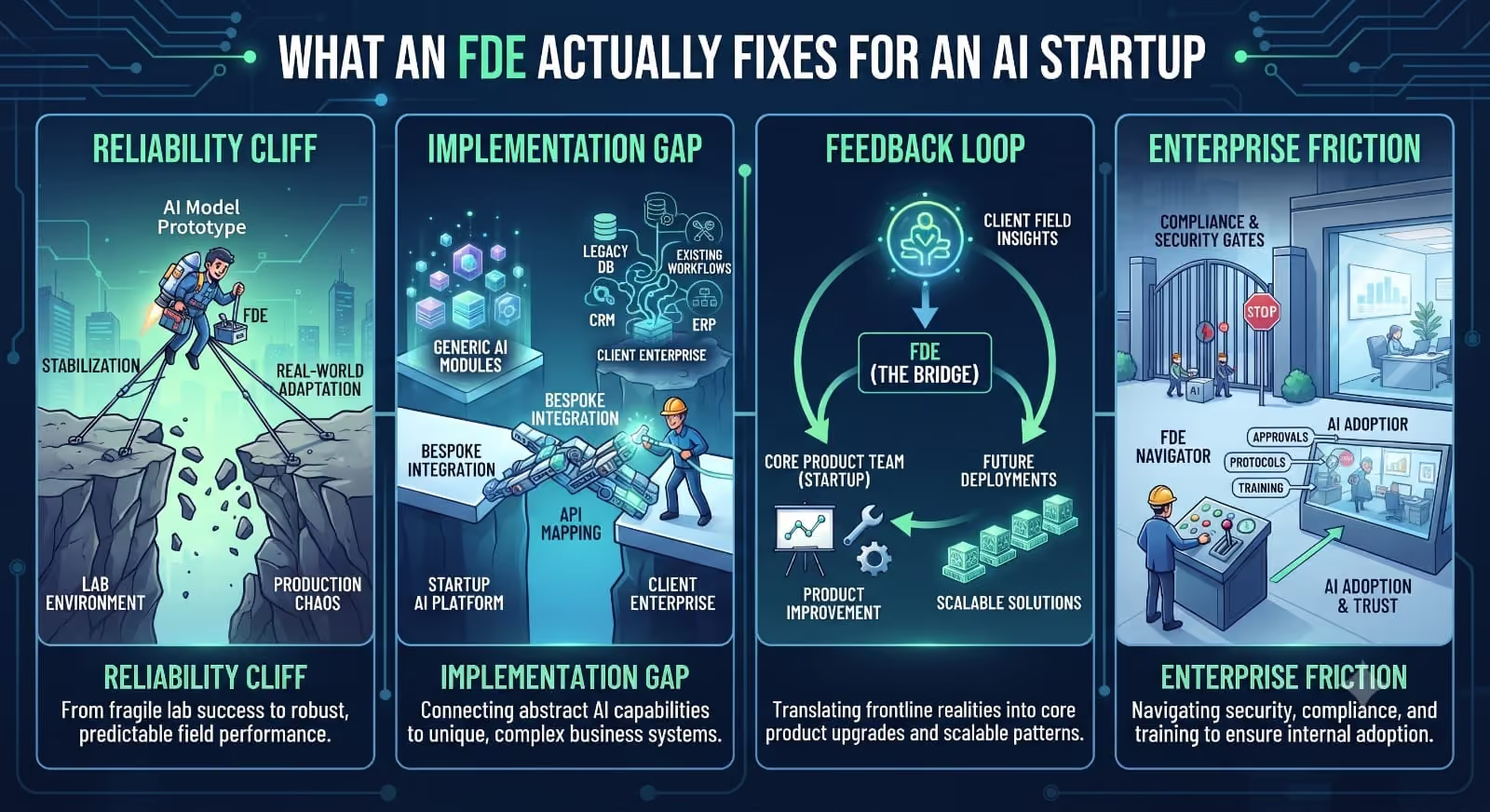
You're probably past the point of waiting if more than one of these is true: your team has closed an enterprise deal that requires meaningful custom integration work, your core engineers are spending a significant share of their time on one specific customer's issues instead of the product roadmap, a pilot has stalled or nearly churned because of a deployment problem rather than a product problem, or you've noticed the same integration pattern coming up across multiple prospective customers, a signal that a dedicated deployment function would pay for itself immediately.
The clearest single trigger: the moment your core product engineers start resenting customer-specific work because it's pulling them off the roadmap they actually want to be building, that resentment is a direct signal you need a role built for exactly that work, not more general engineers absorbing it as a distraction.
If your customers are mostly self-serve, technically unsophisticated buyers who adopt your product without meaningful custom integration, you likely don't need a dedicated FDE yet, the deployment gap this role solves simply hasn't materialized at scale. Similarly, if you're pre-product-market-fit and still iterating on what the product even is, hiring for deployment specialization before you know what's being deployed is premature, that role becomes valuable once you have a real product hitting real, messy customer environments repeatedly, not before.
A useful rule of thumb: if you can count your enterprise-scale customers on one hand and none of them have required serious custom integration work yet, you likely have time. The moment that changes, even for a single high-value account, the calculus shifts fast.
Early-stage startups facing their first serious enterprise deployment often don't need a full-time hire immediately. A fractional Forward Deployed Engineer can absorb the deployment work for a specific customer engagement without committing to permanent headcount before you know your deployment volume will sustain one, a genuinely useful bridge for startups closing their first few enterprise customers.
Once deployment volume becomes sustained rather than occasional, a full-time FDE hire typically pays for itself quickly: the role directly protects your core engineering roadmap, increases the odds enterprise pilots convert to renewals, and generates the field feedback that makes your product genuinely better suited to the customers you're trying to win. For founders building out this function for the first time, our guide on why companies are hiring Forward Deployed Engineers covers the broader market context driving this hiring wave across companies of every size, not just startups.
The hiring decision itself is worth taking seriously rather than treating as a generic engineering req. The candidates who succeed in this role rarely look like typical backend hires on paper, prior customer-facing experience, comfort with ambiguity, and evidence of having actually shipped something into a messy, real environment matter more than years of experience alone. Founders hiring their first FDE often get better signal from a structured case study or portfolio review than from a standard technical interview loop built for product engineering roles.
The gap between a working AI demo and a working AI deployment is where enterprise deals actually get won or lost, and it's a gap that general engineering headcount isn't built to close efficiently. A Forward Deployed Engineer exists specifically for that gap: discovery that surfaces the real requirement, integration work that doesn't derail your core roadmap, evaluation rigor that catches failures before customers do, and a feedback loop that makes your product genuinely better. The startups that recognize this early, rather than after a painful stalled pilot, tend to convert enterprise deals faster and build a product that actually fits what enterprise customers need.
Because the skill set is different, not just the headcount. Core product engineers optimize for many users and one codebase. FDEs specialize in rapid context-switching, customer discovery, and owning deployment inside one specific, messy customer environment. Adding general engineering headcount doesn't solve a problem that's fundamentally about deployment specialization.
Once you've closed an enterprise deal requiring meaningful custom integration, or once your core engineers are spending significant time on customer-specific issues instead of the roadmap. Before that point, a fractional FDE engagement is usually a better fit than a full-time hire.
Deployment work falls to core product engineers, pulling them off the roadmap, or gets absorbed poorly by sales and customer success teams without the technical depth to solve it. Both outcomes commonly show up as stalled pilots, missed renewals, and integration problems that damage enterprise relationships.
Yes, and it's a common and sensible bridge for startups with occasional rather than sustained deployment volume. A fractional FDE can absorb a specific customer engagement without the startup committing to permanent headcount before deployment volume justifies it.
A solutions engineer typically supports pre-sales demos and proofs of concept. An FDE owns production deployment end to end, writing and shipping the actual integration code and staying accountable through stabilization, not handing off once a deal closes.
Both. The patterns an FDE encounters across real customer deployments become direct signal for the product roadmap, the same integration gap or missing feature showing up repeatedly across customers is exactly the kind of field feedback that makes a startup's core product better suited to the market it's selling into.
The world is hiring - and this Academy prepares you for it.