Blogs
Can a Forward Deployed Engineer Work on Multiple AI Models (OpenAI, Claude, Gemini) at Once?
Can a Forward Deployed Engineer Work on Multiple AI Models (OpenAI, Claude, Gemini) at Once?
By
August 12, 2026

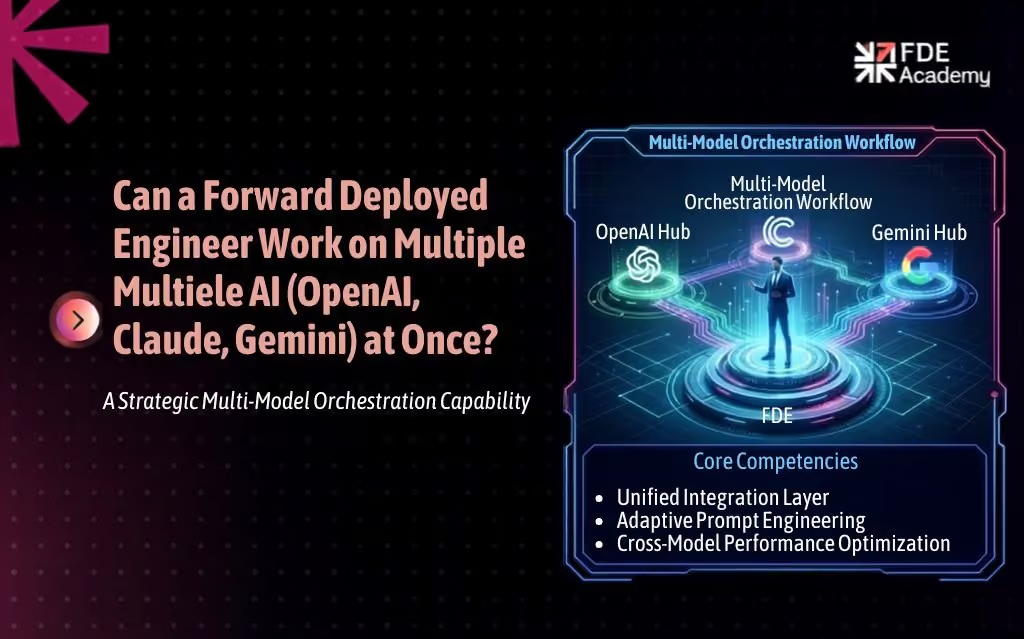
If you picture a Forward Deployed Engineer (FDE) as someone married to a single AI vendor, drop that image. The honest answer is yes a Forward Deployed Engineer can, and very often does, work on multiple AI models like OpenAI, Claude, and Gemini at the same time, sometimes inside the very same production system. Enterprise clients don't standardize on one model provider, and neither does the FDE role that serves them.
This isn't a theoretical capability. It's a daily reality for engineers embedded inside client organizations, where the "best" model changes by use case, cost ceiling, latency requirement, and even data residency rule.
Understanding how FDEs actually manage this multi-model juggling act tells you a lot about what the role really demands and why it's becoming one of the most valuable positions in applied AI.
Working across multiple models doesn't mean copy-pasting the same prompt into three chat windows. It means designing a system where different requests, workflows, or fallback conditions route to different underlying models GPT-4o for one function, Claude for another, Gemini for a third often within a single application, and frequently without the end user ever knowing which model answered them.
A Forward Deployed Engineer sits at the intersection of the client's business problem and the available AI tooling. Because that tooling spans multiple vendors, multi-model fluency isn't a bonus skill; it's close to a baseline expectation once a system moves past the prototype stage.
Large organizations hedge. Procurement, security review, and compliance teams push for at least two approved model providers so the business isn't dependent on a single API's uptime, pricing, or policy changes. An FDE walking into a Fortune 500 account will frequently find OpenAI already licensed for one department, Claude approved for another due to its enterprise trust posture, and Gemini in play because of an existing Google Cloud relationship. The FDE has to make all three work together, not lobby for a single favorite.
Model selection is a technical decision, not a brand preference. Some models are stronger at long-context document reasoning, some at structured tool-calling, some at coding assistance, some at multimodal image or video understanding, and some at raw cost-efficiency for high-volume, low-complexity requests.
A production-grade system routes each task to the model best suited for it, which is exactly why the FDE Academy curriculum's production RAG systems and multi-model builds are designed around comparing model behavior rather than defaulting to one.
If a single provider has an outage or a rate-limit spike, a system built around only one model goes down with it. FDEs design fallback chains if the primary model fails or times out, the request reroutes to a secondary model automatically. This is standard practice in any AI system expected to run in production, not an edge case.
Multi-model systems are rarely built with raw API calls scattered across a codebase. Instead, FDEs use an orchestration or routing layer that decides, per request, which model to call based on task type, cost budget, latency tolerance, or a client-defined policy.
This is closely tied to the broader discipline of AI agent orchestration, where agentic frameworks coordinate multiple models and tools inside one workflow rather than relying on a single monolithic call.
To avoid rewriting integration code every time a client adds or swaps a provider, FDEs lean on unified API gateways tools such as LiteLLM, Portkey, and Helicone that normalize the request and response format across OpenAI, Claude, and Gemini.
This is the same pattern behind "OpenAI Playground alternative" builds inside real FDE work, where multi-model testing, cost tracking, and versioning happen through one interface instead of three separate SDKs. It's a core reason multi-model fluency shows up so heavily in any serious Forward Deployed Engineer tech stack.
Here's where the real engineering skill shows up. GPT, Claude, and Gemini don't respond identically to the same prompt structure; they have different tokenization behavior, different system-prompt conventions, different tool-calling schemas, and different tolerances for verbosity.
An FDE can't assume a prompt tuned for one model will transfer cleanly to another. Part of the job is building an evaluation harness that scores each model's output against the same task, so decisions about which model handles which workflow are based on measured accuracy and cost, not guesswork. Tools like LangSmith and Weights & Biases are commonly used here to track these comparisons over time.
Every model has a different price-per-token and a different response time. Running the most capable (and most expensive) model for every request burns the budget fast. FDEs typically tier requests; a cheaper, faster model handles high-volume simple queries, while a more capable model is reserved for complex reasoning tasks.
Getting this tiering wrong is one of the more common mistakes new Forward Deployed Engineers make early in a deployment.
When three models can answer the same question differently, maintaining a consistent tone, factual accuracy, and compliance posture across all of them becomes a genuine challenge especially in regulated industries. This is where AI governance practices like guardrails, PII filtering, and output validation have to be applied uniformly across every model in the stack, not just the primary one.
Multi-model architecture is partly a defensive strategy. Clients don't want to be trapped if a vendor changes its pricing, deprecates a model, or shifts its API. An FDE who builds a system tightly coupled to one provider's quirks is creating technical debt the client will eventually have to unwind. Designing for portability from day one is part of what separates a durable deployment from a fragile one.
Working fluently across OpenAI, Claude, and Gemini demands more than API familiarity. It requires:
These are exactly the competencies covered inside FDE Academy's Learn → Apply → Build loop, where learners work with 30+ GenAI tools and multiple model providers across realistic company simulations rather than a single fixed stack. That range of exposure connects directly to broader Forward Deployed Engineer skills that hiring teams now expect as standard, not advanced.
Yes and it's becoming more central, not less. As enterprises formalize multi-vendor AI strategies, the FDE is often the person responsible for making that strategy technically workable. This matters even more given how AI agents are changing the Forward Deployed Engineer role; agentic systems frequently call multiple models mid-workflow (one for planning, another for execution, another for verification), which pushes multi-model fluency from "nice to have" into "structurally required."
It's also worth noting this isn't unique to any one provider's ecosystem. Whether an engineer's background leans toward an OpenAI Forward Deployed Engineer path or an Anthropic Forward Deployed Engineer path, the underlying skill set deploying, evaluating, and owning AI systems in production transfers across vendors.
The role was never defined by a single model; it's defined by the outcome of making AI work reliably inside a real organization. And yes despite common assumptions, otherwise Forward Deployed Engineers do write and own real code to build these multi-model integrations, they don't just configure dashboards.
Multi-model competence isn't something most engineers pick up from tutorials, because most tutorials are built around a single provider's documentation. FDE Academy's 8-month PGP in FDE & Applied AI Solutions is structured differently the FDE Lab™ model has learners building with GPT-4o, Claude Opus, and other providers side by side across realistic case studies like production RAG systems, multi-tenant SaaS architecture, and healthcare-grade AI deployments.
The curriculum's dual-track structure (technical execution alongside consulting delivery) mirrors how real engagements force multi-vendor decisions in the first place; a client rarely asks "build this in GPT" or "build this in Claude." They ask "solve this problem," and the model choice is the FDE's call to make.
If this is the kind of hands-on, multi-model, production-grade training you're evaluating, it's worth exploring what the Forward Deployed Engineer role actually covers before choosing a learning path.
Forward Deployed Engineers often work with multiple AI models such as OpenAI, Claude, and Gemini, choosing the right model based on accuracy, cost, latency, task requirements, and reliability. They use model routing, orchestration layers, and abstraction tools like LiteLLM and Portkey to integrate and switch between providers.
Multi-model FDE work also requires prompt engineering, model evaluation, cost optimization, fallback design, and AI governance. Ultimately, an FDE is vendor-neutral and focuses on delivering reliable AI solutions rather than being tied to a single model provider.
No. Most FDEs are expected to be provider-agnostic. Specializing too narrowly in one vendor's ecosystem limits an engineer's ability to serve clients who use multiple models, which is now the norm rather than the exception.
Yes, in the sense that it adds orchestration, evaluation, and cost-tracking overhead. But this complexity is exactly what production systems require, and it's a core part of what makes the FDE role technically demanding and well compensated.
Common tools include LiteLLM, Portkey, and Helicone for unified API access; LangSmith and Weights & Biases for evaluation and monitoring; and orchestration frameworks like LangGraph or Semantic Kernel for routing logic between models.
It's introduced early and built up over time. Understanding one model deeply first is useful, but production-ready FDEs are expected to compare and route across providers well before they're deploying independently.
Yes. Each model family has different conventions for system prompts, tool-calling, and context handling, so prompts are rarely portable without adjustment and testing.
The world is hiring - and this Academy prepares you for it.