Blogs
The FDE Academy Method: How Forward Deployed Engineer Training Actually Works
The FDE Academy Method: How Forward Deployed Engineer Training Actually Works
By
R&D, FDE Academy
September 24, 2026

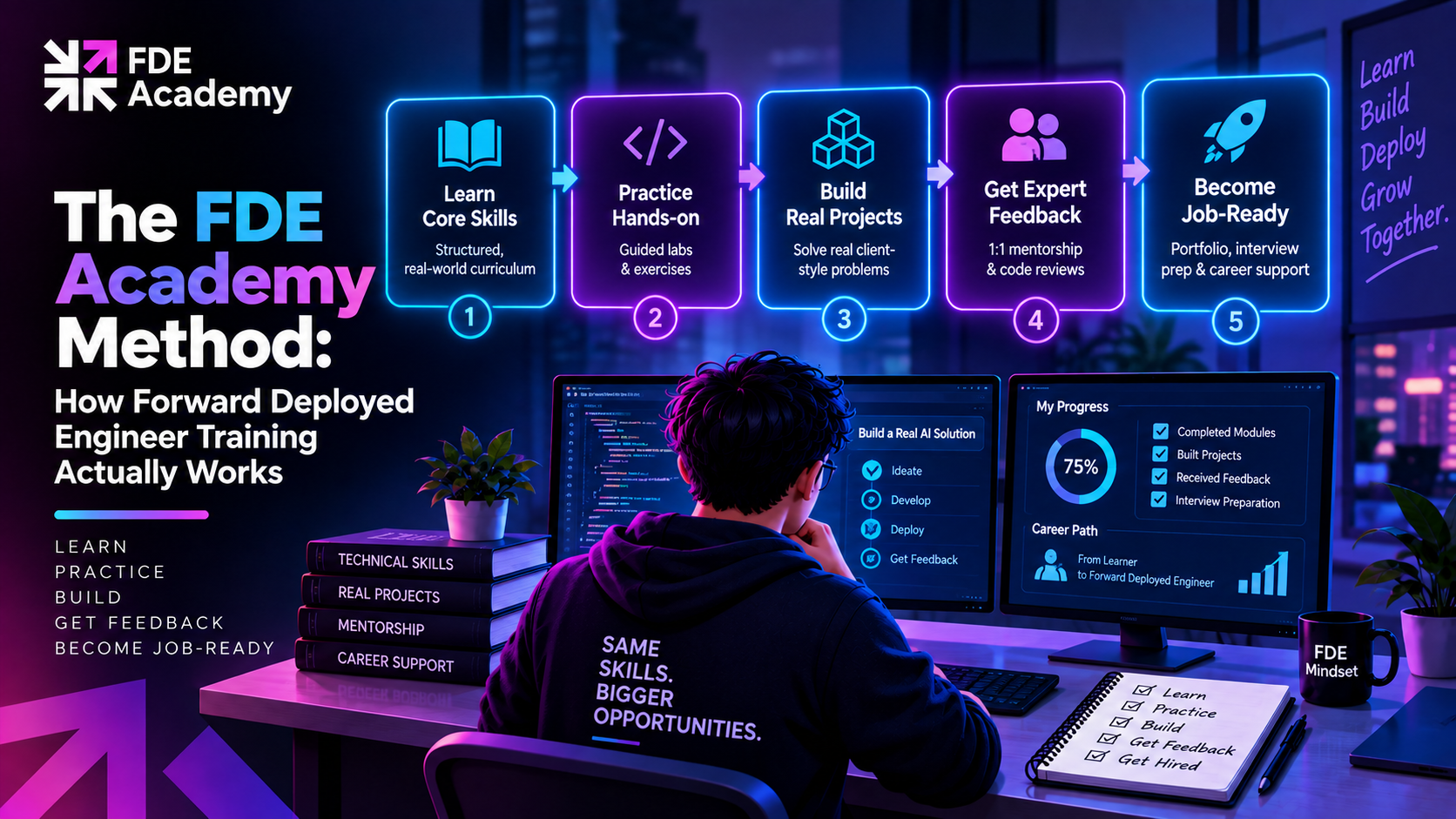
Forward Deployed Engineering is unusual among technical roles in exactly the way that makes generic training approaches fail it. The role blends software engineering with domain understanding and direct collaboration with end users three distinct skill sets that most training programs teach in isolation, if they teach the non-technical half at all. A candidate can walk out of a purely technical bootcamp able to write clean code and still be unprepared for the customer-facing ambiguity that defines the actual job. This is precisely the gap a named, deliberate methodology exists to close.
For the underlying role definition this training builds toward, see our guide to Forward Deployed Engineer. And if you're still weighing whether structured training is worth it at all versus teaching yourself, our comparison of Self-Study vs. a Structured FDE Program covers that broader decision directly.
The starting principle behind the FDE Academy Method is a direct rejection of how most training in this space is currently built. Most programs optimize for certification; FDE Academy optimizes for capability and ownership. The distinction isn't rhetorical it shapes every structural decision in the program, from how curriculum is sequenced to how graduates are evaluated at the end.
The focus is not topic completion, but preparing engineers to deploy, own, and scale AI systems under real-world constraints. That single sentence is the clearest expression of what separates this approach from a conventional course: the measure of success isn't whether a module was completed, it's whether the engineer can actually do the job once the program ends.
A methodology is only as good as what it's built from, and this is where the FDE Academy Method makes a specific, verifiable claim: the curriculum is grounded in real Forward Deployed work, drawing on insights from 160+ FDE roles and inputs from practicing engineers, hiring teams, and employers, ensuring alignment with what production-ready engineers are actually expected to deliver.
This matters because FDE hiring bars vary meaningfully across companies and even across postings at the same company. A curriculum built from a single company's playbook, or from a generic AI engineering syllabus with "FDE" applied as a label, risks preparing candidates for a narrower or different bar than what the broader market actually screens for. Grounding the program in a wide sample of real roles is a direct attempt to close that specific risk.
At the center of the method is a proprietary learning system: FDE Lab™️, built on a continuous loop learn production patterns, apply them to realistic company scenarios, and build end-to-end systems evaluated for real-world readiness.
Each stage of the loop does distinct work. Learn covers production patterns directly not abstract theory, but the specific technical and delivery patterns that recur across real FDE engagements. Apply moves that pattern into a realistic company scenario, forcing the learner to handle the ambiguity and constraints of a semi-realistic customer situation rather than a clean, textbook exercise. Build is the synthesis stage: constructing an end-to-end system and having it evaluated specifically for real-world readiness, not just correctness against a rubric.
The loop repeats rather than running once, which is a deliberate design choice a single pass through learn-apply-build teaches a pattern; repeated passes across different scenarios build the judgment to recognize which pattern applies when the "right answer" isn't obvious, which is closer to how the actual job works day to day.
One of the more distinctive structural choices in the FDE Academy Method is running two tracks simultaneously rather than sequentially. Both tracks run in parallel throughout the program, reflecting how Forward Deployed Engineers operate in production environments because in real FDE work, the technical build and the customer-facing translation work aren't separate phases you complete one after the other; they happen at the same time, on the same problem, often in the same conversation.
The technical track builds the production engineering depth the coding, integration, and deployment competencies our guide on the skills an FDE actually needs covers at the individual-skill level. The consulting-style track builds the discovery, stakeholder-translation, and ambiguity-navigation skills that determine whether a technically sound system actually gets adopted. Teaching these as one integrated discipline, rather than a technical course with a soft-skills module bolted on, is a direct structural response to how the real role is documented to function: you need to be a strong engineer and a high-empathy communicator who can manage a high-stakes relationship, not one or the other in sequence.
The program follows a structured cadence with live weekday sessions and deeper weekend builds, with a typical commitment of roughly 14–18 hours per week depending on the phase. This intensity is presented as intentional rather than incidental the rigor is intentional because the role demands it, reflecting the same standard the program is training candidates to meet, not an artificially inflated workload for its own sake.
Unlike most self-paced certifications, entry into the program is deliberately gated. The process includes a proficiency test, a technical interview, a field readiness evaluation, and a final FDE Board decision with the explicit goal of assessing aptitude and ownership potential, not just current skill levels.
This selectivity is itself part of the methodology, not just an admissions formality. Screening for aptitude and ownership potential rather than only current technical skill reflects a bet that the underlying traits successful FDEs share (comfort with ambiguity, genuine customer-facing instinct, a bias toward shipping) matter as much as a snapshot of today's skill level, since skill is buildable within the program but temperament is harder to teach from scratch. If you want to check your own standing against the field's general eligibility bar before applying, our guide to Forward Deployed Engineer eligibility is a useful gut-check first.
The program's output is deliberately concrete rather than abstract. Graduates complete a deployment-ready portfolio reviewed code, architecture artifacts, and a capstone demonstrating end-to-end ownership alongside PGP Certification from FDE Academy and Professional Certification in association with a partner IIT. Learners also receive lifetime access to a role-specific FDE community.
This output maps directly onto what hiring managers actually screen for in this role. Our guide on the Forward Deployed Engineer resume and portfolio guide covers why a demonstrable, reviewable portfolio carries more weight in FDE hiring than a certificate alone precisely the gap the program's capstone and portfolio requirement is built to close. The community component matters too, and connects to a real structural gap in the field: since no dedicated Forward Deployed Engineer community has fully consolidated yet, the FDE Academy alumni directory functions as genuine, structured peer infrastructure rather than a nominal perk.
The broader FDE training market spans everything from 30-hour self-paced certifications to full postgraduate programs our comparison of Forward Deployed Engineer course options walks through that full landscape by tier. What this article adds is depth on one specific program's methodology rather than a market-wide comparison: the Learn → Apply → Build loop, the parallel dual-track structure, and the selective, board-based admissions process are specific design choices, not generic program features, and they're the reasons this approach sits at the deeper end of that market's tier structure rather than the fast, self-paced end.
TL;DR: Most Forward Deployed Engineer training optimizes for certification topic completion, a badge, a line on a resume. The FDE Academy Method optimizes for something different: capability and ownership. Built around a proprietary Learn → Apply → Build loop and grounded in insights from 160+ real FDE roles, the program runs a dual-track curriculum technical and consulting-style delivery in parallel, mirroring how the role actually operates in production, rather than teaching the two halves as separate, disconnected subjects.
The FDE Academy Method is a training approach built around a proprietary Learn → Apply → Build loop (called FDE Lab™️), a dual-track curriculum that teaches technical and consulting-style delivery skills in parallel, and a curriculum grounded in insights from 160+ real Forward Deployed Engineer roles rather than a generic engineering syllabus.
Most certification courses optimize for topic completion finishing modules and passing an assessment. The FDE Academy Method optimizes for demonstrated capability and ownership, evaluating graduates through a deployment-ready portfolio and capstone project rather than course completion alone.
It's the core learning cycle behind the program: Learn covers real production patterns from actual FDE work, Apply puts that pattern to work against a realistic company scenario, and Build has the learner construct and get evaluated on an end-to-end system for real-world readiness, with the loop repeating across different scenarios.
Because that's how the real job works Forward Deployed Engineers handle technical building and customer-facing translation simultaneously in practice, not as separate sequential phases. Teaching the two tracks in parallel is meant to mirror that reality rather than artificially separating skills that are used together on the job.
No. Admission is deliberately selective, involving a proficiency test, a technical interview, a field readiness evaluation, and a final board decision, with the explicit goal of assessing aptitude and ownership potential alongside current skill level, not just processing enrollments.
Graduates complete a deployment-ready portfolio with reviewed code, architecture artifacts, and a capstone project, along with PGP Certification from FDE Academy, Professional Certification in association with a partner IIT, and lifetime access to a role-specific alumni community.
The world is hiring - and this Academy prepares you for it.