Blogs
MCP for Forward Deployed Engineers: Connecting AI to Enterprise Systems
MCP for Forward Deployed Engineers: Connecting AI to Enterprise Systems
By
R&D, FDE Academy
September 30, 2026

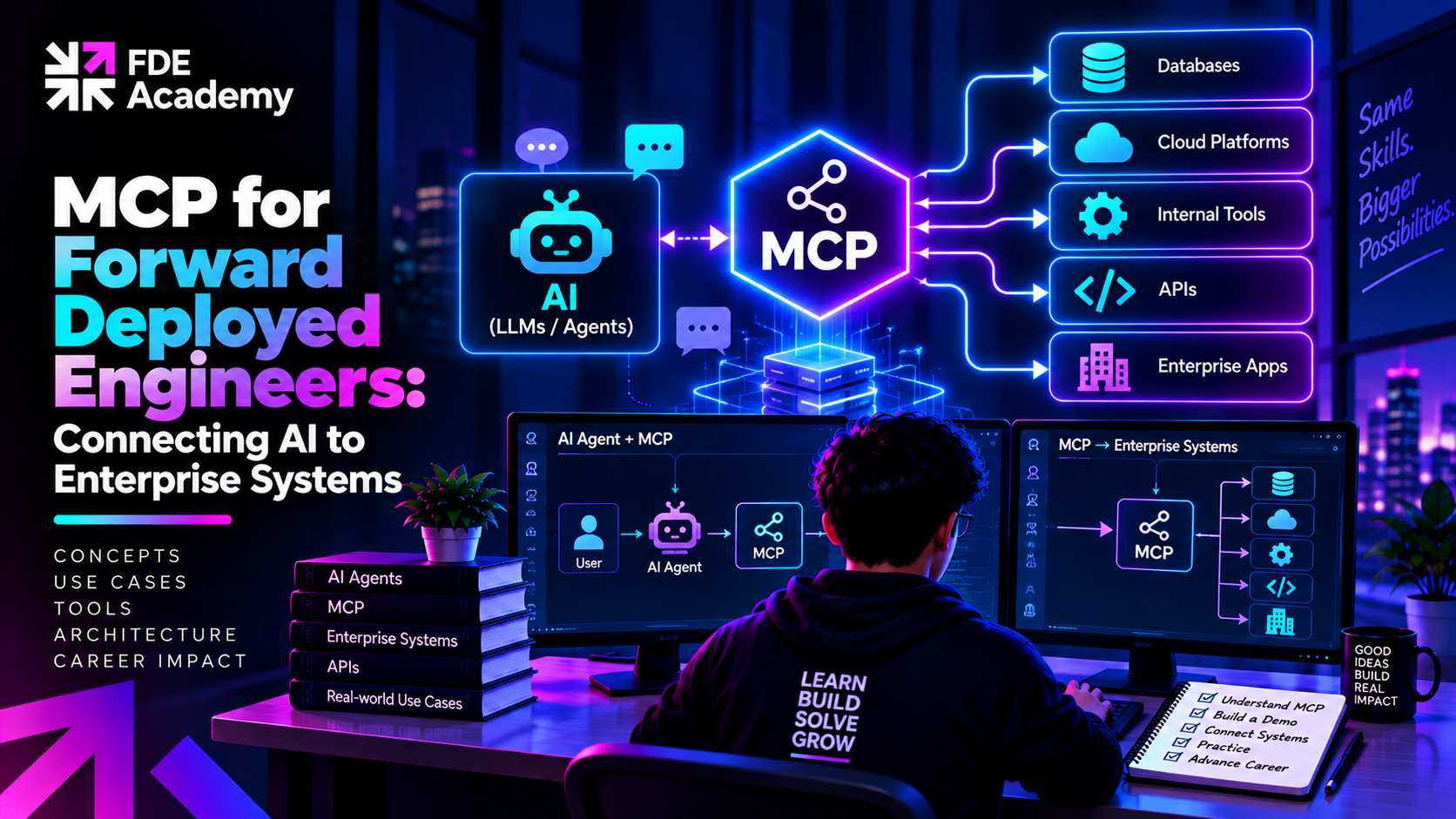
Before MCP existed, connecting an AI application to an enterprise system a CRM, a data warehouse, an internal API, a document repository meant writing custom integration code specific to that model, that tool, and often that specific client's setup. Every new client environment meant re-solving largely the same integration problem from scratch, even when the underlying tools (Salesforce, a Postgres database, a Slack workspace) were things you'd integrated with before on a different engagement.
This is precisely the kind of repeated, constraint-heavy integration work that defines Forward Deployed Engineering, as described across the technical skills an FDE actually needs and the broader set of tools used by Forward Deployed Engineers. MCP directly addresses the most repetitive part of that work: instead of writing bespoke glue code between a specific AI model and a specific tool every time, you build (or reuse) a standardized MCP server for that tool once, and it works with any MCP-compatible AI application going forward.
MCP is an open protocol that standardizes how AI applications connect to external data sources and tools. It defines a common interface think of it as a universal connector so that an AI model doesn't need a custom-built integration for every different tool it might need to use. Instead, tools and data sources expose themselves through an "MCP server," and any AI application that speaks MCP (an "MCP client") can discover and use that server's capabilities without needing tool-specific integration code baked into the application itself.
The architecture has three core pieces:
This separation is the entire point: a company that builds an MCP server for their internal ticketing system once can have it used by any MCP-compatible AI application their teams adopt, rather than needing a new custom integration every time they change AI tooling.
The practical effect for FDE work specifically: a portion of what used to be genuinely custom, one-off integration engineering becomes closer to configuration and reuse freeing up time for the parts of an engagement that are genuinely unique to that client's business problem, rather than the connectivity plumbing underneath it.
Connecting AI agents to client data sources. Rather than writing custom retrieval code for every client's specific database or document store, an FDE can stand up an MCP server for that data source (or use an existing one, since MCP servers exist for many common systems already) and have any MCP-compatible agent immediately able to query it.
Standardizing tool access across a multi-agent system. In more complex deployments involving multiple cooperating agents, MCP gives every agent in the system a consistent way to access shared tools and data, rather than each agent needing its own bespoke integration layer directly relevant to the kind of setups covered in AI agent orchestration for Forward Deployed Engineers.
Reducing integration rework across client engagements. Since many enterprise clients use overlapping categories of tools (a CRM, a ticketing system, a data warehouse), an FDE who has built or adapted MCP servers for common tool categories can bring that work forward into new engagements, rather than starting integration work from zero every time a direct, compounding efficiency gain across a career's worth of engagements.
Building client-specific MCP servers for proprietary internal systems. Not every system a client uses has an existing MCP server available. Part of the FDE's job increasingly includes building a lightweight, client-specific MCP server for a proprietary internal tool or legacy system, so that AI agents can interact with it through the same standard interface used for everything else in the stack a task that draws directly on the kind of legacy-system integration judgment tested in FDE system design interviews.
MCP servers, by design, expose real access to real systems and data which means the same security discipline that applies to any production integration applies here, arguably more so given how directly an AI agent can act through an MCP connection. FDEs building or deploying MCP servers in client environments need to think carefully about authentication and authorization scoping (what can this server actually do, and as whom), auditability (can every action taken through this connection be traced), and the blast radius of a compromised or misconfigured server, since an MCP server sitting between an AI agent and a sensitive enterprise system is a meaningful part of that system's overall attack surface, not just a convenience layer.
This isn't a reason to avoid MCP it's a reason to treat MCP server development with the same production rigor as any other piece of infrastructure an FDE ships into a client's environment, consistent with the "build within real constraints" step of the FDE Work Cycle.
MCP has seen rapid, broad adoption since its introduction, with growing ecosystem support across major AI providers and a fast-growing library of community and vendor-built MCP servers for common enterprise tools. For FDEs specifically, this trajectory matters less as an abstract industry trend and more as a practical skill-investment decision: understanding MCP well enough to build, adapt, and securely deploy MCP servers is becoming a genuinely useful, increasingly expected part of the FDE technical toolkit, alongside the broader shift covered in why AI agents are changing the Forward Deployed Engineer role.
TL;DR: MCP (Model Context Protocol) is an open standard for connecting AI models to external tools, data, and systems through a consistent interface, instead of writing a custom integration for every tool an AI application needs to use. For Forward Deployed Engineers whose entire job is connecting AI systems to a specific client's real, messy enterprise environment MCP turns a category of repetitive, bespoke integration work into a repeatable pattern: build or reuse an MCP server once, and any MCP-compatible AI application can use it, across clients and projects.
MCP is an open standard that lets AI applications connect to external tools and data sources through a consistent interface, instead of requiring a custom-built integration for every different tool. A tool exposes itself through an "MCP server," and any MCP-compatible AI application can use it without tool-specific integration code.
FDE work centers on connecting AI systems to a specific client's real enterprise environment. MCP turns much of that repetitive integration work into a reusable pattern build or adapt an MCP server once, and it can be reused across clients and engagements, rather than rebuilding custom integration code every time.
A traditional API integration is typically built for one specific application-to-tool pairing and needs to be rebuilt or adapted for each new context. An MCP server is built once against the standard protocol and can be used by any MCP-compatible client, including future AI tools that didn't exist when the server was built.
Both, depending on the engagement. Many common enterprise tools already have existing MCP servers available for reuse, but proprietary or legacy internal systems specific to a client often require building a custom MCP server, which is an increasingly common part of an FDE's technical work.
An MCP server provides real access to real systems, so authentication scoping, authorization boundaries, and auditability all matter significantly an MCP server should be treated with the same production security rigor as any other integration into a client's environment, not as a lightweight convenience layer.
Not entirely MCP standardizes how AI applications discover and use tools, but the underlying APIs and systems still exist underneath it. What changes is that the integration layer connecting AI to those systems becomes standardized and reusable, reducing (though not eliminating) the need for fully custom, one-off integration work.
The world is hiring - and this Academy prepares you for it.