Blogs
Palantir Deployment Strategist vs Forward Deployed Engineer: What's the Real Difference?
Palantir Deployment Strategist vs Forward Deployed Engineer: What's the Real Difference?
By
R&D, FDE Academy
October 2, 2026

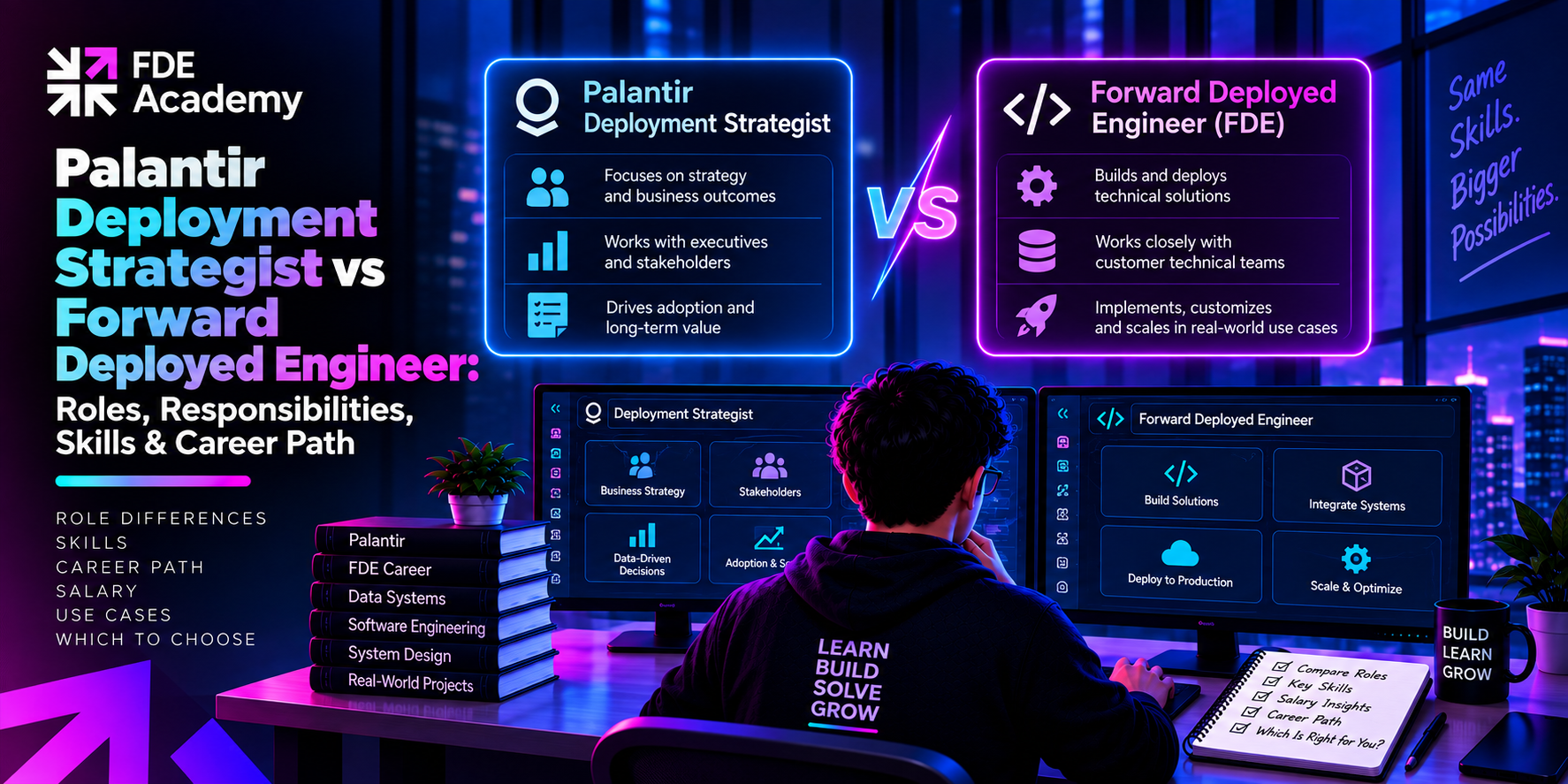
If you're researching roles at Palantir, you've likely noticed that "Forward Deployed Engineer" and "Deployment Strategist" show up described in strikingly similar language: both work directly embedded with clients, both are responsible for turning a client's real operational problem into a working deployment on Foundry, and both are held accountable for whether that deployment actually succeeds. This is genuinely confusing, and it's made more confusing by the fact that Palantir itself has publicly acknowledged the overlap Palantir's own blog post on the Deployment Strategist role states directly that "both roles are a mix between product manager, software engineer and strategist and the lines between the two roles blur heavily quite often."
Understanding where they genuinely differ and where they don't matters if you're deciding which role to apply for, preparing for an interview, or just trying to understand Palantir's org structure as part of researching how Palantir invented the Forward Deployed Engineer model in the first place.
A Forward Deployed Engineer at Palantir (internally, a "Delta") is primarily responsible for the technical build: writing code, building data pipelines, integrating with a client's existing systems, and constructing the actual applications and workflows running on top of Foundry. The work is embedded directly with the client, meaning an FDE sees firsthand how their technical decisions play out in the client's real operational environment not abstracted away behind a product requirements document handed off from someone else.
This technical-build emphasis is consistent with how the FDE role is generally understood across the industry, not just at Palantir see our broader definitional guide to Forward Deployed Engineer for the general pattern this specializes from.
A Deployment Strategist at Palantir (internally, an "Echo") leans more toward the product-and-strategy side of the same embedded, client-facing work. Based on Palantir's own description of the role, a Strategist's day might involve understanding a client's operations deeply enough to design a workflow that actually fits how they work, iterating directly with end-users to refine that workflow, managing the client relationship and project timeline, and notably still implementing solutions and sometimes writing real code, just with less of the role's identity built around the technical build itself.
The clearest way to think about the distinction, in Palantir's own framing: "Echos are more product-managers while Deltas are more technical." This mirrors the kind of comparison covered in our FDE vs AI Product Manager guide a Deployment Strategist sits meaningfully closer to that product-manager end of the spectrum than a traditional FDE does, without being a pure product manager role either.
Not exactly, though the roles overlap heavily. By Palantir's own description, Forward Deployed Engineers ("Deltas") lean more technical, while Deployment Strategists ("Echos") lean more toward product strategy and client relationship management but both do embedded, client-facing deployment work on Foundry, and individuals in either role often do tasks associated with the other.
Some do, extensively; others rarely. Palantir's own account of the role describes highly variable technical involvement depending on the individual and the specific client engagement, rather than a fixed coding requirement.
Compensation structures for both roles are broadly comparable at Palantir, since both are considered core, strategically important embedded deployment roles. For specific FDE compensation figures, see our dedicated guide to Palantir FDE salary.
Given how much Palantir itself emphasizes that individuals "shape their own role" based on engagement needs and personal strengths, movement between the two is plausible and consistent with how the company describes career flexibility internally, though specifics depend on individual circumstances and should be confirmed directly with Palantir during the hiring process.
Having both titles lets Palantir recruit and develop talent with different natural strengths deeply technical builders and product-and-relationship-oriented strategists while still delivering the same embedded, client-facing deployment model that defines Palantir's broader approach to enterprise software.
The specific titles are Palantir's own internal naming, but the underlying tension a more technical-build-focused role versus a more strategy-and-relationship-focused role, both embedded with the client shows up in similar forms at other companies running forward-deployed-style models, even when they don't use these exact two titles.
The world is hiring - and this Academy prepares you for it.