Blogs
FDE vs AI Product Manager: What's the Difference?
FDE vs AI Product Manager: What's the Difference?
By
R&D, FDE Academy
September 5, 2026

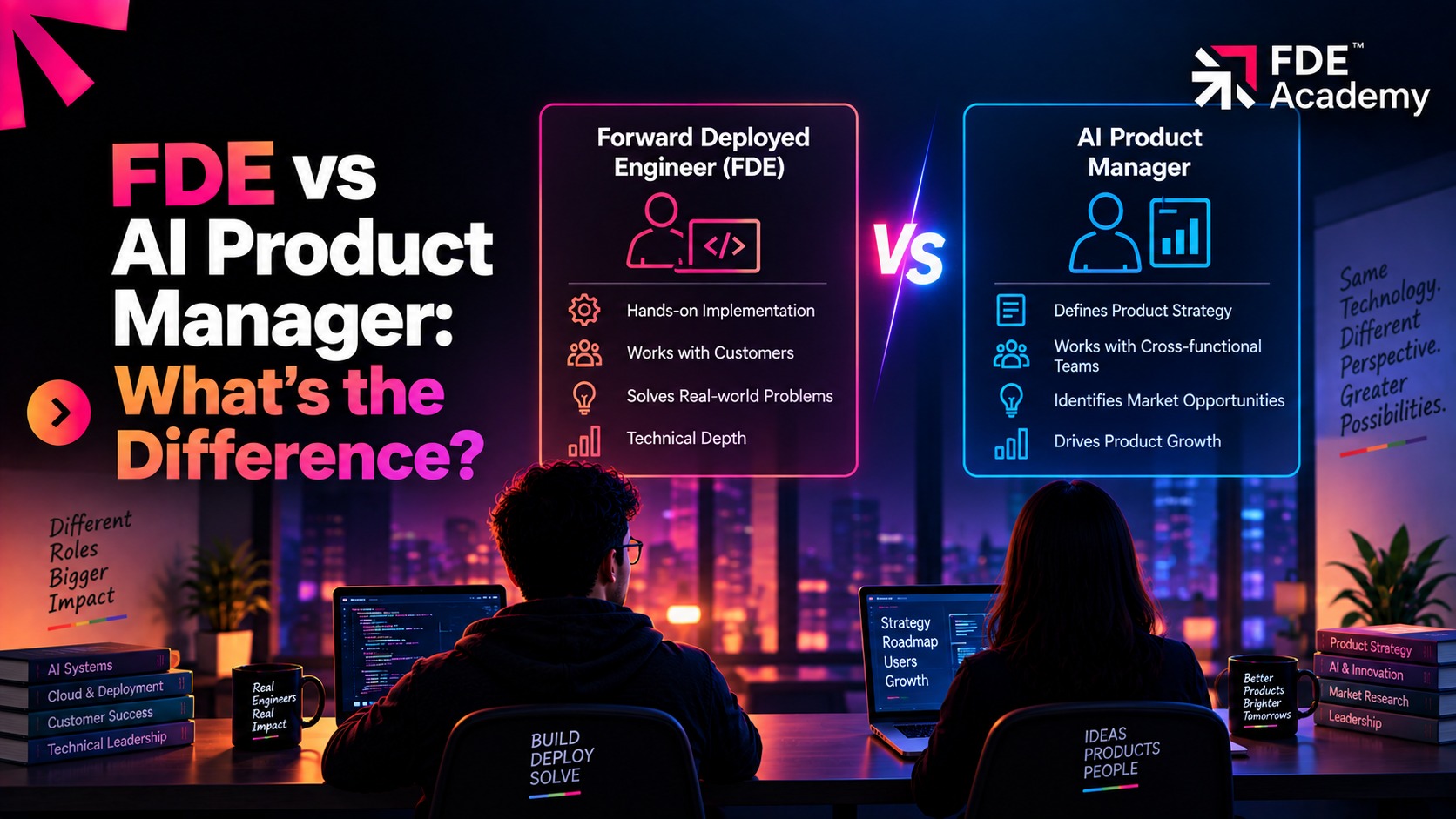
TL;DR: A Forward Deployed Engineer (FDE) builds and ships working code inside one specific customer's environment, owning a deep, immediate outcome for that account. An AI Product Manager defines the strategy and roadmap for an AI product used by many customers, owning a broad outcome that has to generalize across a market rather than solve one company's specific problem. Both roles work at the intersection of AI and customer needs but one is measured on whether this customer's deployment succeeds, and the other is measured on whether the product succeeds at scale.
Both roles sit unusually close to the customer for their category, and both have exploded in hiring alongside the shift from AI pilots to production AI.
FDE job postings grew from 643 in April 2025 to 5,330 in April 2026 a 729% year-over-year surge, making it one of the fastest-growing roles in tech, and AI Product Management has seen a comparably sharp rise as AI-native products moved from experimental features to core product lines. That parallel growth, plus genuine overlap in who touches customer feedback and technical trade-offs, is exactly why the two titles get compared and sometimes confused.
For the foundational definition this comparison builds on, see our guide to Forward Deployed Engineer. It's also worth noting a related, easily-confused hybrid title: our guide to AI Product Engineer already distinguishes that specific role from FDE. Briefly this article goes deeper specifically on the AI Product Manager comparison, which is a different, more strategy-focused role than the hands-on-building AI Product Engineer title.
A Forward Deployed Engineer is a customer-embedded software engineer who writes production code to deploy, integrate, and customize an AI or software product inside a specific customer's environment.
Unlike traditional software engineers who build core products in isolation, FDEs write code that integrates the core product with the client's legacy systems, and an FDE's impact is deep and immediate focused on making specific enterprise clients successful.The role has been described as wearing three hats at once consultant, product manager, and software engineer applied to a single high-stakes customer relationship, which is exactly where some of the confusion with AI Product Management starts: an FDE does real product-management-shaped work, just scoped to one account rather than an entire market.
An AI Product Manager owns the vision, strategy, and roadmap for an AI-powered product used by a broad customer base, deciding what features to build, how AI capabilities should behave for users generally, and how the product should evolve to serve market needs rather than any single customer's specific requirements.
A PM's impact is broad; they focus on building features that can scale to thousands or millions of users, ensuring the product remains generic enough to serve a massive market rather than just one client. An AI Product Manager typically doesn't write production code personally, instead working through engineering and design teams to translate strategy into a shipped, generalized product.
The clearest way to separate the two: an FDE goes deep on one customer; an AI Product Manager goes broad across many. If a major bank needs a custom machine learning pipeline integrated into their system, the FDE builds it while a PM's job is to decide whether that same capability should become a permanent, generalized part of the product for every customer, or stay a one-off customization.
That distinction between one account vs. the whole market is the single axis almost every other difference in the comparison flows from: how success is measured, how deep the technical involvement runs, and how the day-to-day work is actually structured.
A useful related title worth knowing about, since it sits directly between the two: the Forward Deployed Product Manager (FDPM). The Forward Deployed PM decides which customer requests reveal a genuine pattern worth generalizing into the product and which are specific to one customer, then defends that call to both sides operating on the boundary between product, engineering, and go-to-market, carrying customer credibility internally and product credibility externally.
This is a real, distinct hybrid title Scale AI's own Forward Deployed Product Manager role explicitly looks for candidates with technical fluency sufficient to hold a real conversation with a platform engineer about architectural tradeoffs, direct experience with AI/ML platform products, and prior forward-deployed or embedded experience and it's worth distinguishing from a general AI Product Manager role, since FDPM sits much closer to the FDE end of the spectrum than a typical product management title does.
Both roles are unusually customer-facing for their category, and both translate real customer pain into technical or product decisions rather than working from a spec handed down from someone else. Both also require enough technical fluency to be credible in a room with engineers even though only one of them is writing the code.
This overlap is exactly why the hybrid Forward Deployed Product Manager title exists: some organizations have found that certain accounts or product stages need someone who can do both the deep technical translation work of an FDE and the pattern-recognition, generalize-or-don't judgment call of a PM, in one person.
The overlap thins out quickly past that point, though. An FDE's relationship with a customer typically ends (or transitions) once that specific deployment is live and stable; an AI Product Manager's relationship with the market never really ends, since the product keeps evolving as long as it exists. For a fuller picture of how FDE compares to other customer-facing engineering titles specifically, see how FDEs compare to Solutions Engineers, Sales Engineers, and Customer Success Engineers.
An FDE needs genuine software engineering depth, the ability to write, test, and ship production code against messy, undocumented customer environments plus enough customer-facing skill to run discovery and manage a technical relationship directly. Our full breakdown of the skills an FDE actually needs covers this in depth.
An AI Product Manager needs strong market and user research skills, the judgment to prioritize ruthlessly among competing feature requests from many different customers, comfort with product analytics and data-driven decision-making, and enough technical fluency to work credibly with engineering without necessarily being able to code.
FDEs are, first and foremost, engineers, who must understand system architecture, APIs, and data infrastructure a bar an AI Product Manager isn't typically expected to clear to the same depth, even in AI-specific product roles.
An FDE's day typically involves a mix of hands-on coding, debugging a customer's specific environment, running discovery conversations to understand what's actually needed versus what was initially requested, and iterating quickly based on real usage. Our guide to what forward deployed engineers do day-to-day covers this rhythm in more detail.
An AI Product Manager's day typically involves reviewing usage data and customer feedback across many accounts, running prioritization discussions with engineering and design, writing product specs and requirements, and making roadmap trade-off decisions that will affect every user of the product, not just one.
The FDE's day is reactive to one environment's immediate reality; the PM's day is comparative across many environments at once, looking for the pattern worth building rather than the one-off fix.
Compensation for both roles has climbed as AI companies compete for scarce, high-leverage talent, though the underlying drivers differ. FDE pay reflects the combination of deep engineering skill and direct customer ownership see our full Forward Deployed Engineer salary data for a detailed breakdown by experience and company.
Forward Deployed Engineers frequently earn comparable or higher total compensation than AI Engineers at enterprise AI companies, through bonuses, customer-facing incentives, and rapid career progression a pattern that often extends to AI Product Manager comparisons as well, particularly at companies where FDE work is treated as a scarce, high-leverage function tied directly to enterprise contract value.
AI Product Manager compensation, by contrast, tracks more closely with general product management pay bands, scaled up for AI-specific product experience given how competitive that specialization has become.
Choose Forward Deployed Engineering if you want to stay hands-on with code while working directly with customers, and you're energized by solving one specific, messy, high-stakes problem completely rather than making broad prioritization calls across a whole market.
Palantir has summed up the FDE scope memorably: an FDE's responsibilities resemble those of a startup CTO, small teams, high stakes, and end-to-end ownership, which is a very different day-to-day feel from product management's broader, more comparative decision-making. Our guide on how to become a Forward Deployed Engineer lays out the concrete path in.
Choose AI Product Management if you're more energized by strategy, market-wide pattern recognition, and the discipline of deciding what shouldn't be built as much as what should and you're comfortable influencing outcomes primarily through other people's engineering work rather than your own code. If you're drawn to a role that combines real hands-on building with product-level ownership specifically for one customer at a time, the Forward Deployed Product Manager hybrid described above is worth researching directly, since it sits meaningfully closer to the FDE side of this comparison than a typical AI PM role does. It's also worth understanding why companies are hiring Forward Deployed Engineers in the first place. The underlying business problem FDEs solve is a useful lens for understanding why this career path is growing as fast as it is, regardless of which side of this comparison you ultimately choose.
No. A Forward Deployed Engineer writes production code to deploy and customize a product inside one specific customer's environment, while an AI Product Manager defines strategy and roadmap for a product used broadly across many customers, typically without writing production code themselves.
A Forward Deployed Product Manager (FDPM) is a distinct hybrid role that combines FDE-style customer embedding and technical fluency with product-management judgment about which customer requests should be generalized into the core product. It sits closer to the FDE end of the spectrum than a typical AI Product Manager role, which usually has no single-customer embedding component at all.
Both roles command strong compensation at AI-native companies, and the comparison varies significantly by company and level. FDEs often see additional upside through customer-facing bonuses and incentives tied directly to enterprise contract value, while AI Product Manager compensation tends to track more closely with broader product management pay bands adjusted for AI specialization.
Yes, and it's a realistic transition in both directions given the overlap in customer-facing skill and technical fluency. An FDE moving into AI Product Management typically needs to build broader market judgment and prioritization skills beyond single-account problem-solving, while an AI Product Manager moving into FDE work needs to build genuine, independent software engineering ability.
Forward Deployed Engineering is the better fit for staying hands-on with code, since the role requires writing and shipping production code as a core, ongoing part of the job. AI Product Management, including most AI-specific PM roles, generally does not involve writing production code personally.
The world is hiring - and this Academy prepares you for it.