Blogs
7 Signs You Would Be Good at Forward Deployed Engineering
7 Signs You Would Be Good at Forward Deployed Engineering
By
R&D, FDE Academy
September 9, 2026

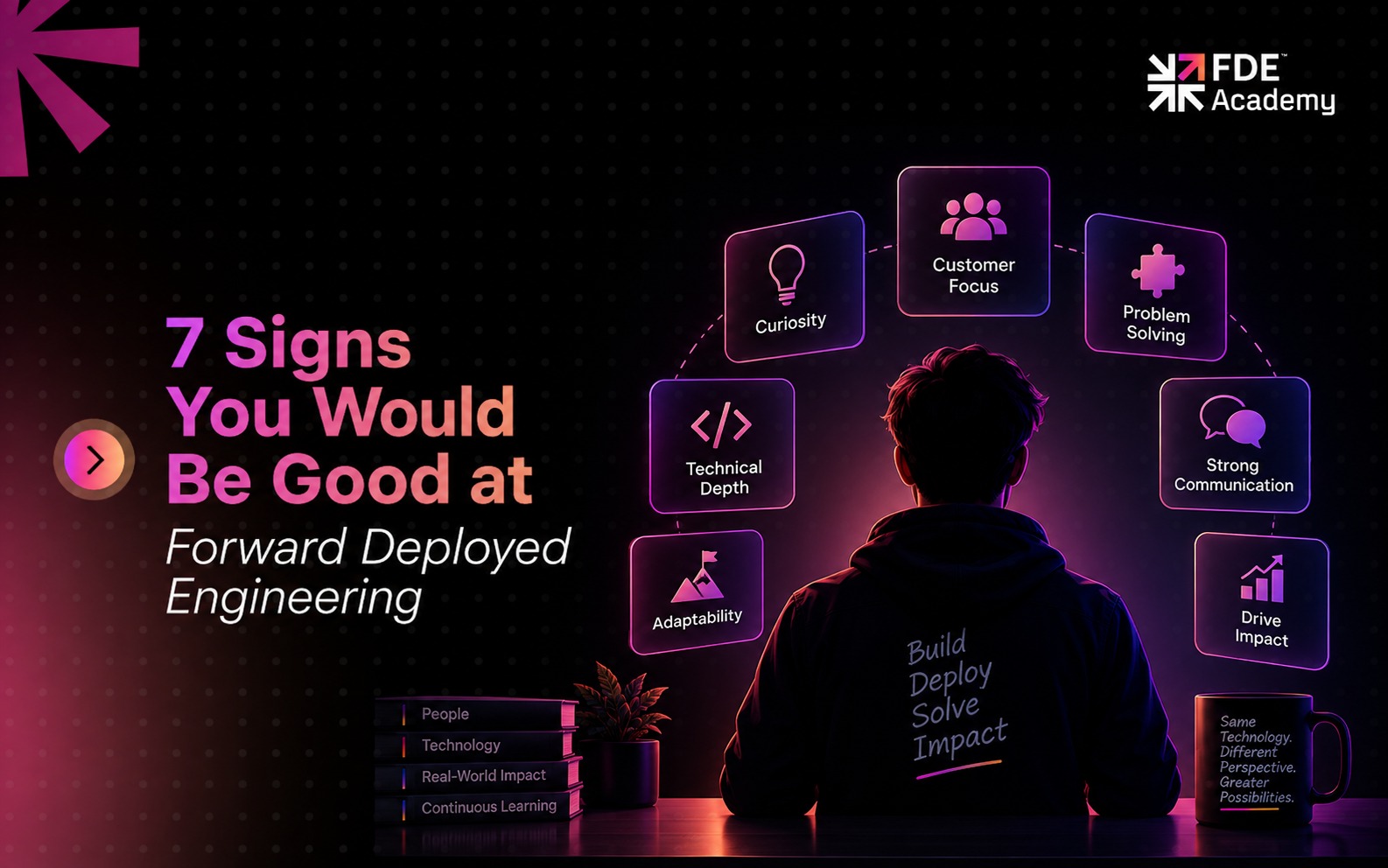
Most FDE preparation content focuses on how to learn languages, frameworks, deployment tools. That's necessary but not sufficient, because FDE work asks something skills alone don't capture: comfort operating without a clear spec, sustained energy in front of a customer, and genuine motivation from outcomes rather than elegant code.
The profile that actually succeeds in forward-deployed work is a renaissance generalist deep enough in business to know what's worth solving, deep enough in AI or engineering to build with it, and deep enough technically to know what's possible and hand off cleanly. That combination shows up in behavior long before it shows up on a resume.
This article is deliberately about signs, not skills for the skills and background-readiness side of the equation, am I ready to become a Forward Deployed Engineer is the right companion resource, organized around your current job title and technical gaps. This piece is meant to come before that one: a way to recognize fit before you've invested in closing any specific skill gap.
If you find yourself getting impatient in architecture debates that go on longer than the actual problem justifies and you're the one in the room asking "can we just try it and see" that instinct maps directly onto FDE work. The role rewards fast, reversible decisions over theoretically perfect ones, because a customer's problem doesn't wait for the ideal solution to get designed on a whiteboard.
Some engineers need a clear spec to do their best work. Others do their best work precisely when the spec doesn't exist yet and they get to define it. An FDE combines hands-on engineering with the autonomy and ownership of a startup CTO, applied to a single high-stakes customer relationship and that autonomy is only energizing if ambiguity feels like opportunity rather than a source of anxiety.
If your favorite projects historically have been the vague, under-defined ones, not the well-specced tickets, that's a genuine signal.
Notice a pattern in your career, even informally: are you the person colleagues or friends come to when they need something technical explained in plain language? This isn't a soft skill you either have or don't consulting-grade discovery means walking into a meeting, extracting the real requirement rather than the stated one, writing a crisp technical summary afterward, and pushing back on scope without losing the room and this isn't a soft skill, it's a technical skill that can be learned, but it's far easier to build on top of an existing instinct for translation than to build from zero.
If you've ever finished your assigned slice of a project and immediately started poking at the parts other people own not out of distrust, but because you're curious how the whole thing fits together and want to be accountable for more of it, restlessness is a real signal.
FDE work is structured around exactly that kind of end-to-end ownership rather than a narrow, well-fenced responsibility. Our breakdown of what forward deployed engineers do day-to-day shows how wide that ownership actually runs in practice from discovery conversations to production debugging within the same week.
Some engineers find comfort in being evaluated on velocity, code quality, or hours of visible effort. Others actively prefer being judged purely on whether the thing worked in a much higher-variance, higher-stakes way to be measured, but one that some people find clarifying rather than stressful. FDE work is unusually outcome-pure in this sense.
FDEs do not carry a sales quota or revenue targets; their performance is measured by engineering milestones, technical delivery, successful implementations, and long-term customer outcomes, not activity metrics. If you've ever felt frustrated being evaluated on anything other than whether the result actually worked, that's worth paying attention to.
A lot of engineers are energized by peer collaboration and slightly drained by being the sole technical voice among non-technical stakeholders. Others feel the opposite genuinely comfortable, even confident, being the only person in a meeting who can answer the hard technical question directly.
FDE work regularly puts you in that second position, sometimes for extended stretches. If you've noticed you don't shrink from that setup and maybe even prefer it to being one voice among many similarly-skilled peers that's a meaningful sign, not just a preference.
This is often the clearest signal of all: look at your actual current job, not your title. Do you already volunteer for the messy customer-facing technical work nobody else wants? The fastest path for a current software engineer moving toward FDE work is to take on the solutions and integration work nobody else wants volunteering to own an enterprise customer proof-of-concept, building the demo, being on the customer call, and doing the FDE work before having the FDE title. If you're already gravitating toward that kind of work informally, inside a role that doesn't officially ask for it, that's not just a sign of fit, it's often already the on-ramp itself.
Recognizing three or four out of seven doesn't disqualify you; these are directional signals, not a pass/fail test, and some of them (particularly comfort with ambiguity and being the sole technical voice in a room) genuinely develop with exposure rather than existing fully formed from day one. It's worth checking whether hesitation on a specific sign comes from an accurate read of yourself or from a misconception about what the role actually demands.
Our piece on common myths about Forward Deployed Engineers is worth reading before ruling yourself out based on an assumption rather than the reality of the job. One especially common misread is around how much of the job is actually coding versus talking our direct answer on whether Forward Deployed Engineers actually code clears that up plainly if it's the source of any doubt.
It's worth being explicit about what this list deliberately leaves out: programming languages, cloud platforms, specific frameworks, or years of experience. None of that is unimportant, it's simply a different question than the one this article answers. Skills are buildable on a timeline you control.
The behavioral patterns above are closer to temperament, and while they're not fixed forever, they're far slower to change and much more predictive of whether the day-to-day reality of the job will actually suit you once the skills are in place.
This is also where this article deliberately differs from two close, related pieces on the site worth reading alongside it. The habits of successful Forward Deployed Engineers and what makes a successful Forward Deployed Engineer both describe traits and behaviors of people already working in the role useful for understanding what excellence looks like once you're in it. This article is scoped earlier: signs worth noticing before you've built the skills at all, to help you decide whether it's worth building them in the first place.
If most of these signs resonated, the honest next step is building the skills these traits alone don't provide technical depth, deployment experience, and a portfolio that demonstrates rather than just claims fit.
Our complete guide on how to become a Forward Deployed Engineer lays out that concrete path, and am I ready to become a Forward Deployed Engineer is the right next stop specifically to identify your biggest current skill gap based on where you're starting from.
Forward Deployed Engineering rewards a specific personality profile more than a specific resume. The signs below are behavioral, not technical; they're patterns you can recognize in how you already work, regardless of your current title, that predict whether the role's mix of ambiguity, ownership, and customer exposure would energize you or wear you down. If you see yourself in most of these, the skills are learnable. The temperament is harder to build from scratch.
Key behavioral signs include preferring fast, imperfect action over prolonged debate, finding ambiguity energizing rather than stressful, a natural instinct for translating technical concepts for non-technical people, discomfort with narrow ownership, wanting to be judged on outcomes rather than effort, comfort being the sole technical voice in a room, and already gravitating toward customer-facing technical work informally.
Yes, strong software engineering fundamentals are a genuine prerequisite for the role but the signs in this article are about temperament and work style, which predict whether you'd thrive once those technical fundamentals are in place, not a substitute for building them.
That's not disqualifying. These are directional signals rather than a pass/fail checklist, and traits like comfort with ambiguity often develop with real exposure to the work rather than existing fully formed beforehand. It's worth checking whether any hesitation comes from an accurate self-read or a misconception about what the role actually involves.
A readiness assessment typically evaluates your current technical skills and background against what the role requires. This article focuses specifically on behavioral and personality signals, the kind of fit that exists independent of, and often before, any specific technical skill-building.
Most of these traits can be developed with deliberate exposure, particularly comfort with ambiguity and being the sole technical voice in a room. They're simply slower to build than technical skills, which is why recognizing an existing inclination toward them is a useful head start rather than a strict requirement.
The world is hiring - and this Academy prepares you for it.