Blogs
AI in Manufacturing: How Forward Deployed Engineers Deploy It
AI in Manufacturing: How Forward Deployed Engineers Deploy It
By
R&D, FDE Academy
October 1, 2026

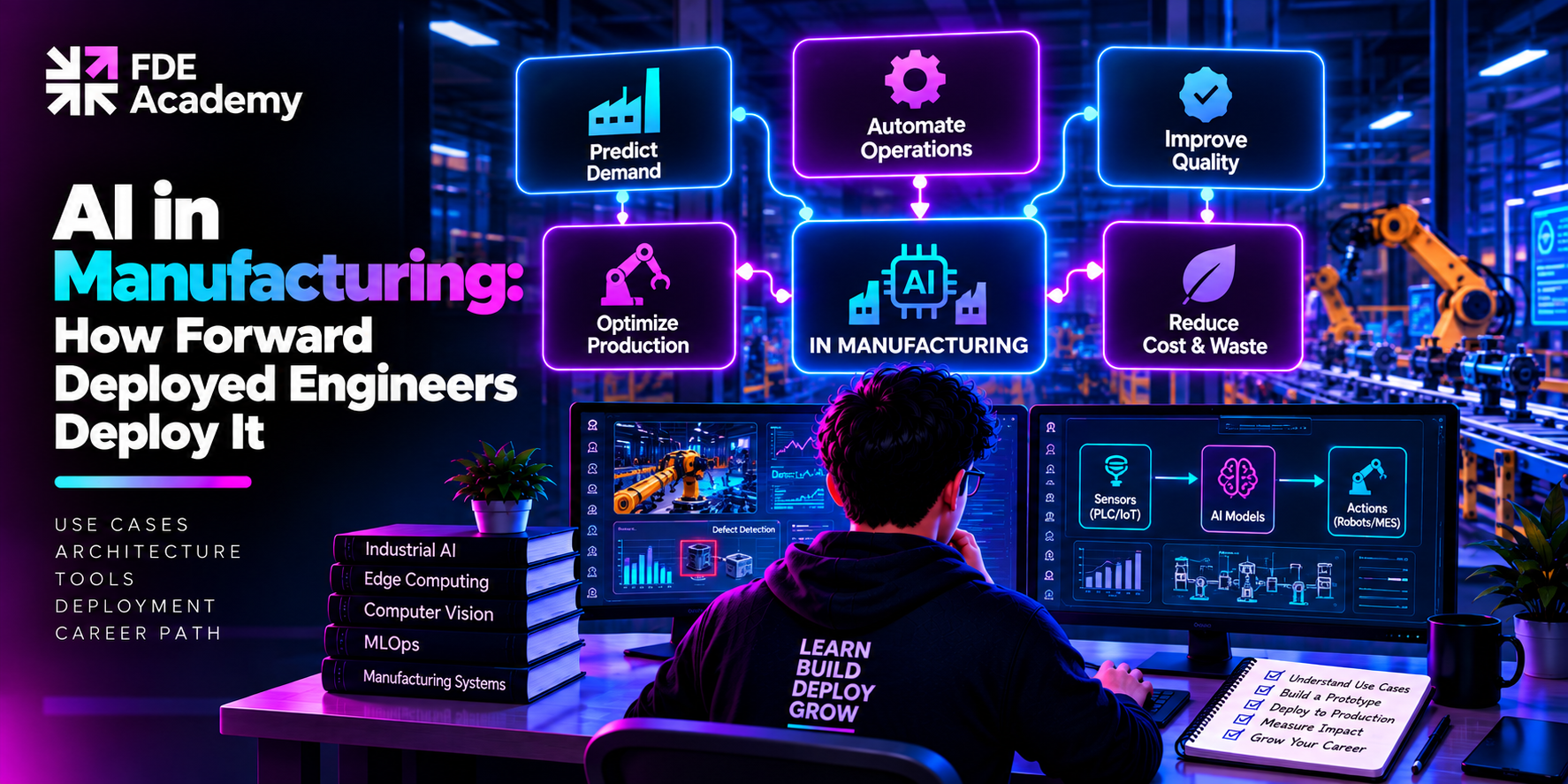
Most discussions of enterprise AI deployment implicitly assume a software-native environment: cloud infrastructure, modern APIs, systems built in the last decade. Manufacturing breaks that assumption immediately. A typical factory runs a mix of industrial control systems and equipment that may be years or decades old, running proprietary protocols never designed to expose data to a modern AI pipeline, alongside newer sensors and MES (Manufacturing Execution System) software that may or may not talk to each other cleanly.
This is precisely the kind of environment covered more broadly in which industries need Forward Deployed Engineers the most manufacturing sits firmly among the industries where the gap between "the AI model works" and "the AI model is actually running reliably in production" is wide enough to require dedicated, hands-on engineering to close, which is the core of what FDEs do as described in how FDEs help enterprises deploy AI.
The OT/IT divide. Operational technology the systems directly controlling physical equipment and information technology the systems handling data and business logic have historically been kept deliberately separate for safety and security reasons. An FDE deploying AI that needs real-time data from OT systems has to navigate this divide carefully, often working with plant engineers who have justified caution about anything touching systems that control physical equipment.
Legacy protocol and system integration. Industrial equipment frequently communicates over protocols like Modbus, OPC-UA, or proprietary vendor protocols rather than modern REST APIs. Building a reliable data pipeline often means writing integration code against systems that were never designed to be integrated with anything, a direct extension of the kind of legacy-system judgment tested in FDE system design interviews.
Physically distributed, noisy sensor data. Unlike a clean application log, sensor data from a factory floor is subject to real physical noise vibration, temperature drift, electrical interference and sensors can fail or drift out of calibration in ways that silently degrade data quality. An FDE working on a predictive maintenance deployment has to account for this at the data pipeline level, not just the model level.
Zero tolerance for production downtime. A software bug in a typical SaaS application might mean a degraded user experience. A bug in an AI system integrated with production equipment can mean a halted production line, a safety incident, or physical damage to equipment which fundamentally changes the risk tolerance, testing rigor, and rollout approach an FDE has to take compared to a standard web application deployment.
Edge deployment constraints. Many manufacturing AI use cases, particularly anything requiring real-time response (like defect detection on a moving production line), can't rely on round-tripping data to the cloud latency requirements push the AI inference itself onto edge hardware physically located on the factory floor, adding a hardware and deployment dimension that most cloud-native AI deployment work doesn't have to consider at all.
Predictive maintenance. Using sensor data (vibration, temperature, acoustic signatures) to predict equipment failure before it happens, allowing maintenance to be scheduled proactively rather than reactively. This remains the most common and most financially justified manufacturing AI use case, since unplanned downtime costs are easy to quantify and the deployment pattern is well-established, even though each specific plant's data integration is usually custom work.
Quality inspection and defect detection. Computer vision models inspecting products on a production line in real time, often requiring edge deployment to meet the latency demands of a moving line, and requiring careful handling of lighting, camera positioning, and the physical realities of a factory floor environment that a model trained on clean lab data won't automatically handle well.
Digital twin-driven process optimization. AI layered on top of a live digital twin of equipment or a production line, used to simulate and recommend process adjustments before they're applied physically. This use case depends heavily on the underlying data integration work being solid, since the digital twin's predictions are only as good as the live data feeding it.
Supply chain and production scheduling optimization. AI-driven optimization of production scheduling and material flow, which usually requires integrating data across multiple plant systems and sometimes across multiple facilities, adding organizational complexity on top of the technical integration challenge.
To understand how to evaluate whether a given manufacturing AI problem is a genuinely good fit for FDE-style deployment work versus a more standard data science project, our broader framework in which AI use cases are best suited for Forward Deployed Engineers applies directly.
The general FDE Work Cycle understand the business reality, define the right problem, design the approach, build within real constraints, deploy to production, and own outcomes holds in manufacturing, but each step carries industry-specific weight. Understanding the business reality means physically understanding the plant floor, not just reading a requirements document many experienced manufacturing FDEs spend real time on-site observing the actual production process before writing any code. Building within real constraints means designing explicitly around the OT/IT divide, legacy protocols, and edge hardware limitations described above, rather than treating them as problems to work around later. And owning outcomes means monitoring a deployed system's performance against metrics that matter on a factory floor unplanned downtime hours, defect escape rate not just typical software metrics like uptime or API latency.
Manufacturing is one of the more technically demanding industries to deploy AI in, precisely because of the constraints described above but that difficulty is also what makes manufacturing-specialized FDEs genuinely valuable and comparatively hard to replace. The skill set required comfort with legacy industrial protocols, OT/IT integration judgment, edge deployment experience, and the patience to work through physical, on-site constraints isn't something most AI engineers build by default, which creates a real specialization advantage for FDEs who develop it deliberately, building on top of the technical skills an FDE actually needs generally.
Manufacturing involves legacy industrial systems and protocols, a hard divide between operational technology (OT) and information technology (IT), physically noisy and distributed sensor data, zero tolerance for production downtime, and often edge deployment requirements constraints that don't typically exist in cloud-native, software-first AI deployments.
Predictive maintenance, computer vision-based quality inspection and defect detection, digital twin-driven process optimization, and supply chain or production scheduling optimization are the most common and well-established manufacturing AI use cases.
Operational technology systems directly control physical equipment and have historically been kept separate from information technology systems for safety and security reasons. Deploying AI that needs real-time OT data requires careful, often collaborative integration work with plant engineers rather than a standard software integration approach.
Many manufacturing use cases, particularly real-time defect detection on a moving production line, have latency requirements that round-tripping data to the cloud can't meet, pushing AI inference onto hardware physically located on the factory floor.
Yes, for FDEs willing to build the specific skill set it requires legacy protocol integration, OT/IT judgment, and edge deployment experience. This difficulty is also what makes manufacturing-specialized FDEs comparatively hard to replace, creating a real specialization advantage.
Often, yes, particularly early in an engagement. Understanding a plant's actual production process, physical layout, and the real operational constraints that don't show up in a requirements document frequently requires on-site observation rather than remote assessment alone.
The world is hiring - and this Academy prepares you for it.