Blogs
How FDEs Help Enterprises Deploy AI
How FDEs Help Enterprises Deploy AI
By
R&D, FDE Academy
September 21, 2026

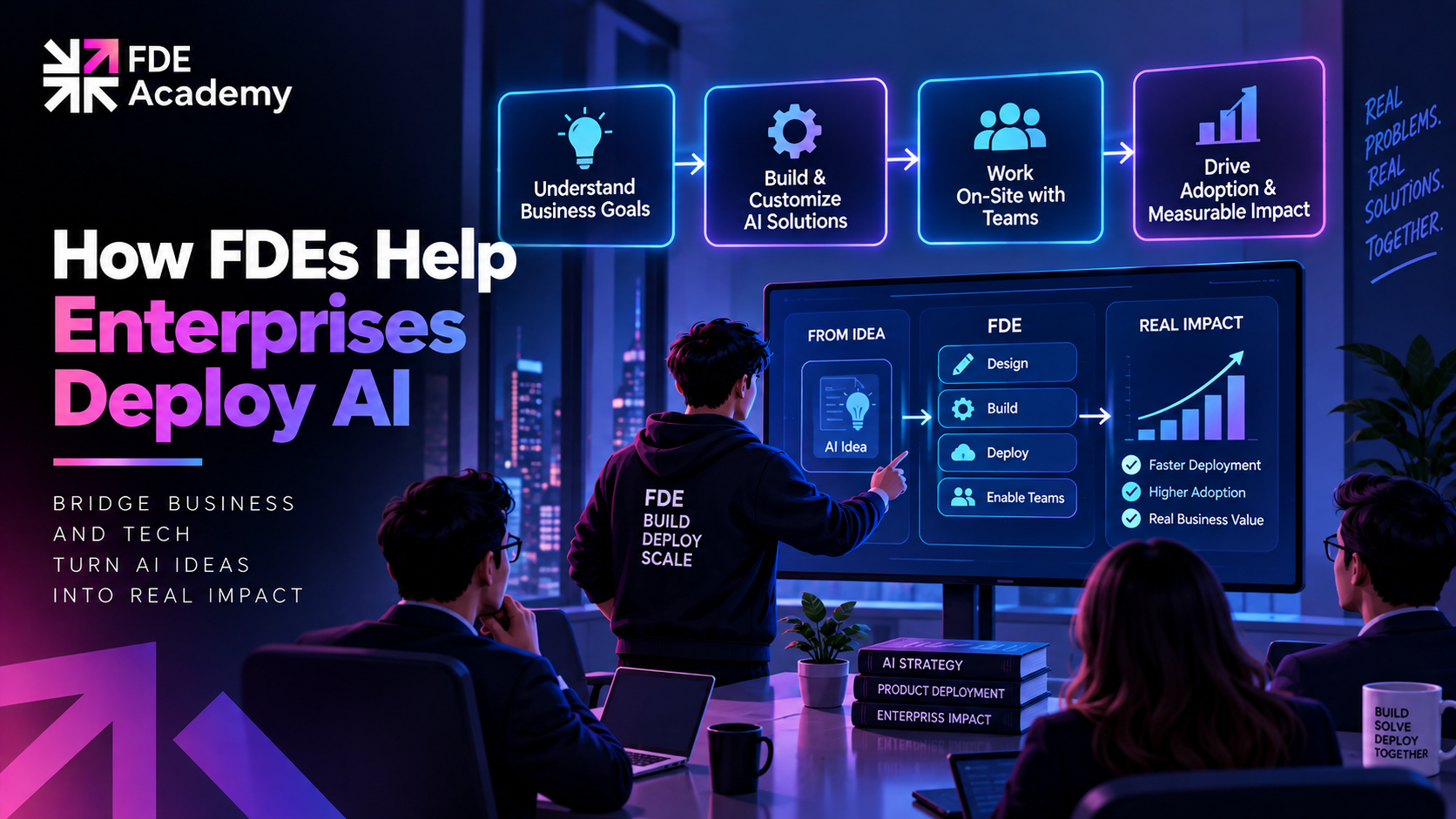
Most discussion of Forward Deployed Engineers in an enterprise context focuses on the business case why the investment is worth it, what the ROI looks like, why companies are hiring for the role at all. Those are legitimate, important questions, and we cover them directly elsewhere: see why enterprise AI adoption fails for the failure-side data, benefits of hiring Forward Deployed Engineers for enterprise AI for the business case, and how FDEs improve AI ROI for the financial outcome framing specifically.
This article answers a different, more mechanical question: what does an FDE actually do, concretely, to move an enterprise from a stalled AI pilot to a working production system. For the underlying role definition, see Forward Deployed Engineer.
The starting context matters, because it explains why a mechanism-level answer is even necessary. Industry research widely cited in enterprise AI adoption discussions has put pilot-to-production failure rates as high as roughly 95%, and while the exact figure varies by study and definition, the underlying pattern is consistent and well established: demonstrating that a model can perform a task in a controlled environment is considerably easier than integrating it into an organization's real technology and operating environment. A pilot can look impressive against clean data and controlled inputs and still fail the moment it meets fragmented systems, security reviews, and users who don't trust where the output came from.
Deloitte's research on enterprise GenAI adoption found that 55% of surveyed organizations avoided certain use cases specifically because of data-related issues not model capability, not budget, but the unglamorous, foundational problem of data not being usable in the first place. This is the exact gap FDE work exists to close, mechanically, not just strategically.
The single most consistent friction point across enterprise AI deployments is integration with legacy infrastructure old ERPs, homegrown CRMs, core systems that predate the AI era by decades. FDEs write custom connective code that links a model or AI application directly into corporate databases, sales software, resource planning platforms, and internal services that were never built with this kind of integration in mind.
This work often starts further back than the AI system itself. In one documented case involving a financial institution running core banking workloads on legacy infrastructure, the FDE team didn't start with the AI chatbot the business wanted they started by exposing core banking capabilities through APIs and modernizing the integration flows connecting key systems first, since the AI layer was never going to work reliably without that foundation in place. This is precisely why FDEs are considered especially well suited to workflows spanning multiple legacy systems an old ERP, a homegrown CRM, spreadsheets nobody wants to touch since no off-the-shelf AI product can safely connect those dots on its own. For a deeper look at which specific use cases this mechanism applies to most, see which AI use cases are best suited for Forward Deployed Engineers.
Before any AI system can be trusted with a real business process, someone has to establish whether the underlying data is actually fit for the job and that work almost always falls to the FDE, not the model. A typical engagement starts by reviewing internal databases, software interfaces, legacy applications, identity tools, and security rules, evaluating data structures, login methods, and access limits against the enterprise's actual data strategy, since data quality alone can decide whether a use case is even viable.
This is deliberately unglamorous, foundational work pipeline building, access provisioning, schema reconciliation that rarely appears in an AI product demo but consistently determines whether the eventual system survives contact with production. Skipping this step is one of the most common reasons a technically impressive pilot never makes it past the sandbox.
A working demo and a production-grade system are different engineering problems, and closing that gap is a core, distinct part of FDE work. This mechanism spans several concrete disciplines: setting up continuous evaluation to catch accuracy drift, meeting enterprise security and compliance requirements, building real-time observability and error tracking, designing resilient hosting infrastructure that holds up under real traffic, and maintaining long-term system stability after launch rather than walking away once the pilot demo succeeds.
For AI systems specifically built around agentic workflows increasingly the norm rather than the exception in 2026 enterprise deployments this mechanism gets more complex still, since orchestration, tool-call reliability, and multi-step failure handling all need to be engineered deliberately rather than assumed. Our guide on how AI agent orchestration works for Forward Deployed Engineers covers this specific layer in depth.
This mechanism is less visible than the engineering work above, but it's arguably the one that most differentiates FDE work from a purely technical integration role. An FDE embedded on-site sits with actual users and stakeholders to translate a vague business goal into a concrete, buildable system closing the gap between what a business leader says they want and what the system actually needs to do, a translation step that frequently gets lost when AI deployment is handled purely through a vendor relationship or a purely internal team without dedicated deployment ownership.
This translation work runs in both directions. It also means surfacing what the AI system genuinely can and can't do yet, managing expectations honestly rather than overselling model capability, and building enough trust with non-technical stakeholders that the system actually gets adopted once it's live trust that a purely remote, ticket-based engineering relationship rarely builds as effectively.
A defining characteristic of a well-run FDE engagement is that it's designed not to create permanent dependence on the embedded engineer. Rather than leaving the customer reliant on ongoing external support, FDEs work directly alongside customer teams throughout the engagement so that, by the end, the organization's own engineers are equipped to maintain, extend, and troubleshoot the system independently.
This matters mechanically, not just as a nice-to-have: research on enterprise AI outcomes has found that systems built with embedded, deployment-focused external partners succeeded roughly twice as often as purely internal builds a notable finding, since it suggests the value isn't just extra headcount, but the specific discipline and pattern-transfer an FDE brings that a team building in isolation often lacks. Knowledge transfer is what converts a one-off deployment win into a capability the enterprise retains long after the engagement ends.
These mechanisms rarely operate in isolation a real engagement typically works several simultaneously, in a sequence that roughly mirrors a project's natural lifecycle. For a structured, phase-by-phase view of how that sequence actually unfolds from first contact through deployment, our companion guide to the FDE project lifecycle from discovery to deployment walks through the process end to end; this article's five mechanisms are the specific, recurring levers an FDE pulls at each stage of that lifecycle, rather than a separate framework.
One industry analysis of 2026 FDE job postings found a rough time split of roughly 60% customer-facing work, 30% deployment-specific code, and 10% internal work a profile that reflects exactly this mechanism mix: substantial engineering effort, balanced against an even larger share of time spent on the translation, trust-building, and stakeholder work that determines whether the engineering effort actually gets adopted.
TL;DR: Enterprise AI pilots don't fail because the models are weak they fail at five specific, recurring friction points: connecting to legacy systems, poor data quality and access, production hardening (security, monitoring, reliability), translating between technical and business stakeholders, and losing momentum after the pilot ends. Forward Deployed Engineers exist specifically to work each of these five points directly, embedded inside the enterprise rather than advising from outside it.
FDEs work across five core mechanisms: integrating AI systems with legacy infrastructure, fixing underlying data quality and access issues, hardening systems for production (security, monitoring, reliability), translating between business stakeholders and the technical system, and transferring capability to customer teams so the deployment doesn't create permanent external dependence.
Pilots often fail not because the AI model underperforms, but because of integration friction with legacy systems, poor data quality, missing security and observability infrastructure, and a lack of trust or adoption from the business stakeholders who need to actually use the system. These are exactly the gaps FDE work is structured to close.
FDEs write custom connective code linking AI systems directly into an enterprise's existing databases, CRMs, ERPs, and internal services sometimes starting by modernizing the underlying integration layer itself before the AI system can reliably connect to it at all.
No. A defining feature of well-run FDE engagements is capability transfer FDEs work alongside customer teams throughout the project specifically so the organization's own engineers can maintain and extend the system independently once the engagement ends, rather than creating ongoing dependence on external support.
Industry analysis of 2026 FDE job postings suggests a rough split of about 60% customer-facing time, 30% deployment-specific code, and 10% internal work reflecting that stakeholder translation and trust-building are as central to the role as the engineering work itself.
The key difference is embedded, hands-on production ownership versus advisory recommendations. FDEs write and ship the actual production code and stay accountable through deployment and adoption, while traditional consulting engagements typically end at a strategy or design recommendation, with implementation handed off to someone else.
The world is hiring - and this Academy prepares you for it.