Blogs
AI Product Engineer: What the Role Actually Involves
AI Product Engineer: What the Role Actually Involves
By
R&D FDE academy
August 26, 2026

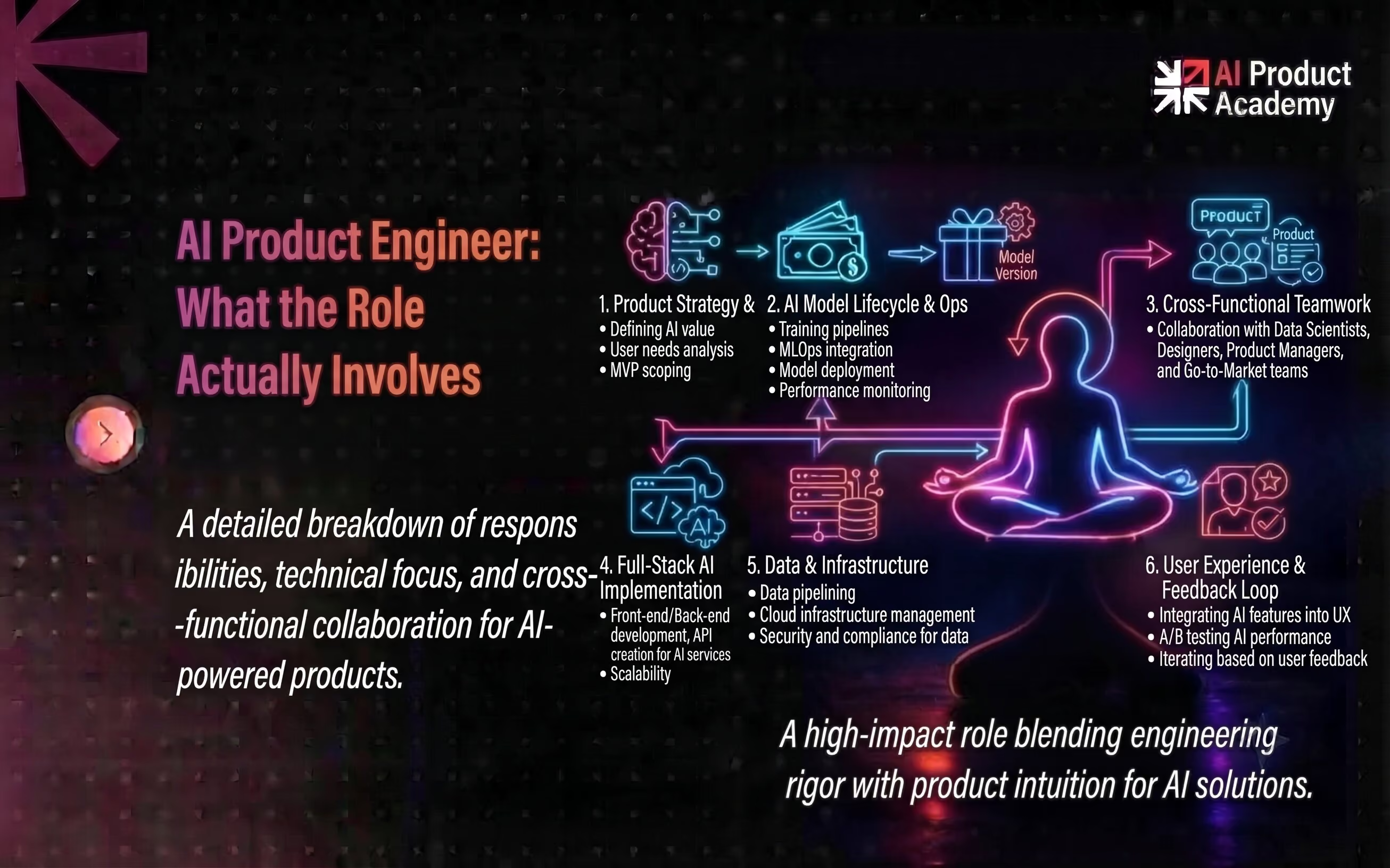
An AI Product Engineer is someone who owns an AI-powered feature end to end: deciding what to build, building it, and shipping it, without handing the work between a product manager and an engineering team. The role sits between product management and engineering. It first got its name around 2023, and by 2026 it shows up in job descriptions at companies like PostHog, Ramp, and a growing list of AI-native startups that no longer split "decide what to build" from "build it" into two separate jobs.
An AI Product Engineer is a hybrid technical role that combines product judgment with hands-on AI-building ability. They identify what users need, prototype a solution using AI tools, and ship it to production, largely on their own. Where a traditional team routes an idea through a PM's spec, a designer's mockup, and an engineering sprint, an AI Product Engineer collapses that chain into one person.
The title varies by company. Some call it "Product Engineer," some "AI Engineer with product ownership," and some quietly redefine a Senior PM role to expect working code. The label matters less than what's being paid for: someone who can go from a user problem to a shipped, working feature without a handoff.
This is distinct from a Forward Deployed Engineer (FDE), a related but different hybrid role. An FDE deploys AI systems inside a specific customer's environment, closing the loop between prototype and production for that one account. An AI Product Engineer, by contrast, builds product features for a broad user base, not a single customer deployment. Both roles emerged from the same shift, AI collapsing the distance between deciding and building, but they point in different directions. More on that comparison further down.
The role exists because the economics of building software changed. AI-assisted coding tools cut the time to a working prototype from weeks to days, so the traditional bottleneck, engineering execution, stopped being the bottleneck. Judgment about what's worth building became the scarce resource instead.
Three forces pushed this into a distinct job title rather than just a skill upgrade for existing PMs and engineers:
The title has a documented origin: writer and engineer Shawn "swyx" Wang laid out a three-stage progression at the first AI Engineer Summit in October 2023, moving from an AI-enhanced engineer, to an AI products engineer who builds AI-powered products, to autonomous AI agents.
Strip away the job-posting language and the daily work breaks into four activities:
At companies like PostHog, AI Product Engineers build large language model-powered features directly into the analytics platform, deciding which AI capabilities users need, prototyping the solution, and shipping it, with no handoff to a separate product manager for the spec.
The gap this role fills is real: most PMs cannot build, and most AI engineers do not develop product instincts as part of their training. The intersection of both skill sets is genuinely scarce, which is part of why the role commands a premium at companies that need it.
Four skill clusters show up consistently across job descriptions and practitioner accounts:
This last point is also where the role overlaps most with the core skill clusters every FDE needs: both roles have to build verification and operational discipline around systems whose core behavior is probabilistic, not just ship code that compiles.
Because the title is new, India-specific salary surveys for "AI Product Engineer" by that exact name don't exist yet the way they do for AI Engineer or AI Product Manager. What's available instead is direct reporting on the role plus comparable data from the two roles it sits between.
An AI Product Engineer role, sitting between these two, would reasonably be expected to track toward the higher end of both bands rather than the middle, since it requires both skill sets rather than one. For a directly comparable India-based hybrid role with public salary data, see Forward Deployed Engineer salary data, which tracks a similarly-scarce combination of engineering and deployment judgment.
Most people who land this role arrive from software engineering and add product instincts, rather than starting as a PM and adding engineering depth. Shipping code is harder to backfill under time pressure than developing product sense.
If the deployment-facing side of this work, taking a prototype into a live customer's environment rather than a broad product, sounds more appealing than product-wide feature ownership, it's worth reading how to become a Forward Deployed Engineer as a parallel path. The two roadmaps overlap heavily in the early stages and diverge mainly in where the work ends up: inside one customer's systems, or inside a shared product.
Both roles are answers to the same underlying shift: AI tools collapsed the distance between deciding what to build and building it, which let one person own more of the lifecycle than used to be possible. Where they diverge is who the work is for.
A Forward Deployed Engineer is embedded with a specific customer, deploying and adapting an AI system inside that customer's environment, often traveling on-site and iterating against that account's constraints. An AI Product Engineer builds features for a broad, often anonymous, user base inside a single product, with no customer-specific deployment work.
In practice:
For a deeper breakdown of this adjacency, see how Forward Deployed Engineers compare to Applied AI Engineers and AI Engineering vs Forward Deployed Engineering, which map the wider set of AI-adjacent hybrid roles this title now sits alongside.
This role fits people who get restless waiting for a handoff, whether that's a PM waiting on engineering or an engineer waiting on a spec. It does not fit people who prefer staying deep in one layer of the stack, or who want the day-to-day structured around a single customer relationship rather than a broad product.
If you're weighing this against a career centered on customer-specific AI deployment rather than product-wide ownership, the Forward Deployed Engineering & Applied AI Solutions program is built for exactly that adjacent path, an 8-month, practitioner-led pathway with a proprietary Learn, Apply, Build loop, designed for engineers who want deployment-facing AI work rather than product-facing AI work.
An AI Product Engineer identifies what users need, prototypes an AI-powered solution using AI-assisted development tools, and ships it to production, largely without handing the work to a separate PM or engineering team. The role owns the full loop from problem to shipped feature.
No. A software engineer typically builds against a spec someone else wrote. An AI Product Engineer decides what to build in addition to building it, and works with probabilistic AI systems that need evaluation practices a traditional software engineer's toolkit doesn't cover.
An AI Product Manager defines strategy, writes specs, and coordinates a team to build; they rarely write production code themselves. An AI Product Engineer does both: deciding what to build and building it, without the handoff between the two.
No degree is strictly required. Employers increasingly prioritize demonstrated skill and shipped projects over formal credentials for this role, since the skill combination is new enough that traditional degree programs don't teach it directly.
For engineers who want product ownership without leaving hands-on building, yes; the role commands a premium precisely because the skill combination is scarce. It suits people comfortable with ambiguity and reluctant to wait on handoffs more than it suits people who prefer a narrowly-scoped technical lane.
An AI Product Engineer builds features for a broad product user base; a Forward Deployed Engineer deploys and adapts AI systems inside one customer's specific environment. Both need the same underlying discipline around shipping and verifying probabilistic AI systems, but the audience and setting differ.
The world is hiring - and this Academy prepares you for it.