Blogs
Can a Product Manager Become a Forward Deployed Engineer?
Can a Product Manager Become a Forward Deployed Engineer?
By
R&D, FDE Academy
September 15, 2026

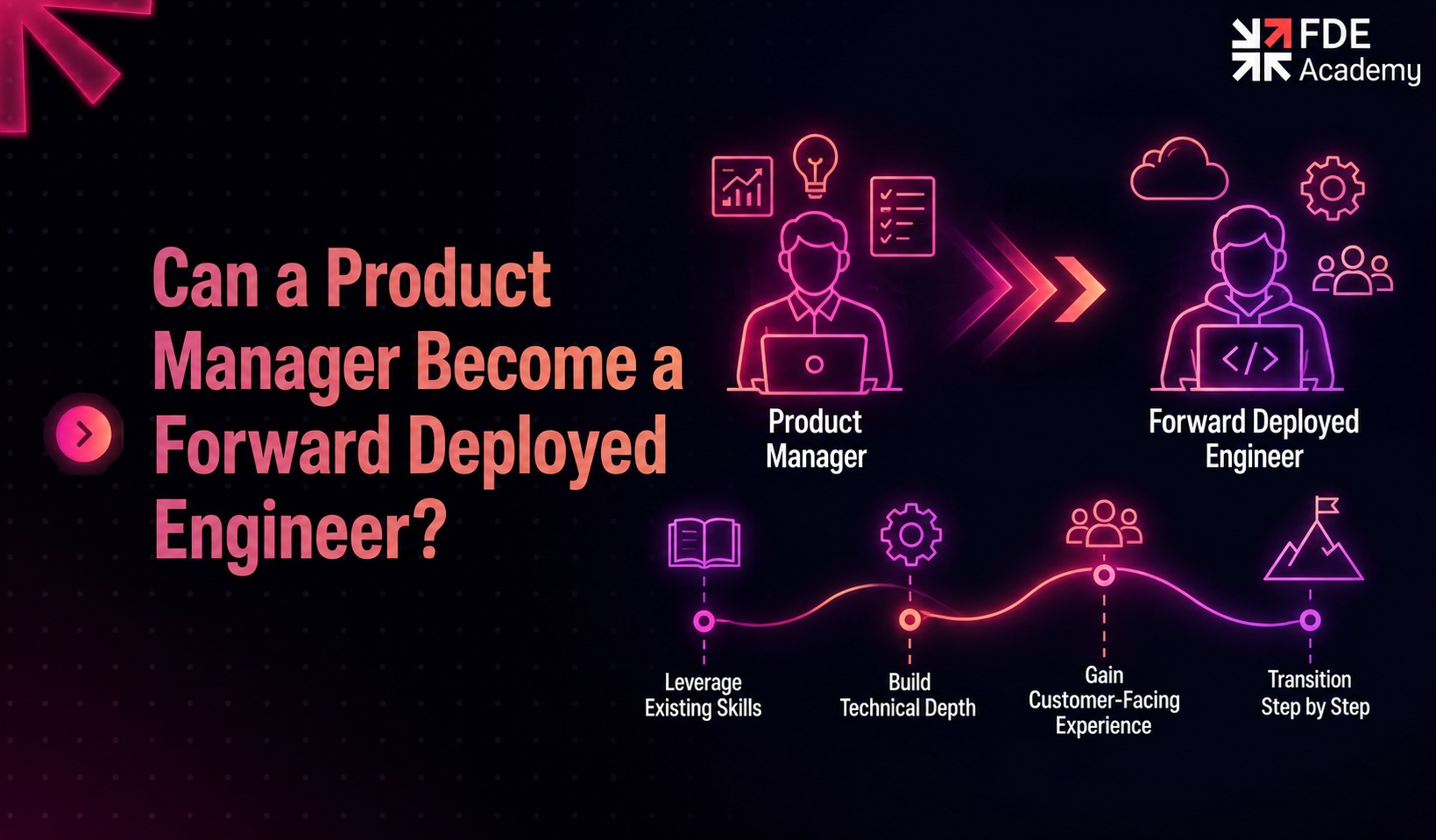
Can a Product Manager become a Forward Deployed Engineer? Yes, but the answer depends on the type of FDE role you're targeting and your current technical skills. Some Forward Deployed Engineer positions require engineers to write and ship production code, while others may have a different technical focus. Before making the transition, it's important to understand the actual requirements of the role rather than assuming that strong product experience alone is enough.
For a foundational explanation of the role, see our guide to Forward Deployed Engineer. You can also compare the two career paths in our guide to FDE vs AI Product Manager.
Product Managers already bring several skills that transfer well to Forward Deployed Engineering.
Customer discovery is one of the biggest advantages. PMs regularly identify what customers actually need instead of simply building what they initially request. This type of problem-solving is also important for FDEs working directly with customers.
Product Managers also typically have experience with:
These skills can give a PM a strong foundation for an FDE or FDE-adjacent role.
The major difference is technical execution. A traditional FDE is still an engineer and may need to understand system architecture, APIs, databases, data infrastructure, and production deployment at a much deeper level.
The biggest gap is usually production code ownership.
A traditional Forward Deployed Engineer may be expected to independently build, test, debug, integrate, and deploy software against a customer's real systems. This is different from managing engineers who perform that work.
A Product Manager may be technically fluent and comfortable discussing software architecture, but that does not necessarily mean they can independently build and debug a production system.
That's why the important question isn't simply, "Am I technical enough to work with engineers?"
A better question is:
Can I independently build, debug, and ship a working technical solution?
If the answer is currently no, there is a genuine technical gap to close. Our guide on whether Forward Deployed Engineers actually code explains how important hands-on development is to the role.
For many Product Managers, a Forward Deployed Product Manager (FDPM) can be a more natural transition.
An FDPM combines product management, customer engagement, and technical implementation. The role can involve working with enterprise customers, driving deployments, identifying product limitations, and communicating customer requirements back to engineering teams.
The technical expectations are different from those of a traditional FDE.
An FDPM should understand areas such as:
However, deep independent production coding is generally not the central requirement.
This makes FDPM an attractive option for PMs who want to move closer to technical implementation without completely restarting their careers as software engineers.
This comparison shows why moving from Product Manager to FDPM can often require a smaller technical transition than moving directly into a traditional FDE role.
If your goal is to become a Forward Deployed Engineer, focus on building practical technical experience rather than only completing theoretical courses.
Start with the fundamentals:
Develop enough programming ability to build and modify real applications. Python is a useful starting point for many AI-focused FDE roles.
Learn how applications communicate with each other and practice connecting APIs to real applications.
Understanding how data is stored, queried, and transferred is important for many customer-facing engineering projects.
Develop a working understanding of cloud infrastructure, deployment, authentication, storage, and basic monitoring.
Projects provide evidence that you can actually apply what you have learned. Instead of only completing tutorials, build applications that solve realistic business problems.
If possible, work directly with engineering teams on integrations, technical discovery, prototypes, or customer implementations. This can provide valuable experience before making a full career transition.
For a more detailed skills breakdown, see our guide to Forward Deployed Engineer skills.
There is no fixed timeline for moving from Product Manager to Forward Deployed Engineer.
An internal transition can be faster if your current employer allows you to work closely with engineering teams and gradually take on technical responsibilities.
Moving to another company while developing your engineering skills from scratch can take considerably longer. For someone targeting a traditional FDE role without an engineering background, building enough technical depth may require a year or more of consistent learning and hands-on practice.
The timeline ultimately depends on your existing technical knowledge, the FDE role you're targeting, and how much real development experience you can gain.
Our guide on how to become a Forward Deployed Engineer provides a broader roadmap for this transition.
The FDE career can be attractive for Product Managers who enjoy solving complex customer problems and want to become more involved in technical implementation.
However, compensation should not be the only reason to make the switch.
The day-to-day work can be substantially different from traditional product management. Instead of primarily focusing on product strategy, prioritization, and roadmaps, FDEs may spend significant time coding, debugging, integrating systems, deploying applications, and solving customer-specific technical problems.
If you're considering the move primarily because of salary, first make sure you actually enjoy this type of technical work.
For more information, see our Forward Deployed Engineer salary guide.
The right path depends on what type of work you want to do.
Consider the FDPM path if you enjoy customer problems, product decisions, stakeholder management, and technical discussions but don't want software development to become your primary responsibility.
Consider the traditional FDE path if you genuinely want to build software, work with APIs and data systems, troubleshoot technical problems, and take ownership of production deployments.
Your Product Management experience can be a significant advantage in either case because you already understand customers, requirements, prioritization, and business outcomes.
However, for a traditional FDE role, you'll still need to develop genuine engineering skills.
Yes, but honestly it depends on which version of "FDE" you're targeting. A traditional FDE role requires shipping real production code, which means a PM without an engineering background has a genuine, non-trivial technical gap to close. A more realistic and increasingly common landing spot is the Forward Deployed Product Manager (FDPM) a real, distinct hybrid title that rewards exactly the skills most product managers already have: stakeholder judgment, requirement translation, and comfort operating in ambiguity, without requiring deep, independent coding ability.
Yes. A Product Manager can transition into a Forward Deployed Engineer role, but they may need to develop stronger skills in software development, APIs, databases, system architecture, and production deployment.
The biggest gap is usually independent production code ownership. Product Managers may already understand technical requirements, but traditional FDE roles can require them to build, test, debug, and deploy working software themselves.
For many Product Managers, yes. A Forward Deployed Product Manager uses existing PM strengths such as customer discovery and stakeholder management while requiring enough technical knowledge to work effectively with engineering teams.
There is no universal timeline. An internal transition can be faster, while moving into a traditional FDE role without an engineering background may require a year or more of sustained technical learning and hands-on project experience.
Yes. Customer discovery, requirement gathering, stakeholder management, prioritization, and business judgment are highly transferable skills. The main challenge is developing the engineering depth required for hands-on implementation.
Choose FDE if you want hands-on engineering and production deployment to be a major part of your work. Choose FDPM if you want to stay closer to product and customer outcomes while developing stronger technical fluency.
The world is hiring - and this Academy prepares you for it.