Blogs
FDE vs Technical Consultant: Roles, Skills, and Responsibilities Compared
FDE vs Technical Consultant: Roles, Skills, and Responsibilities Compared
By
R&D, FDE Academy
September 8, 2026

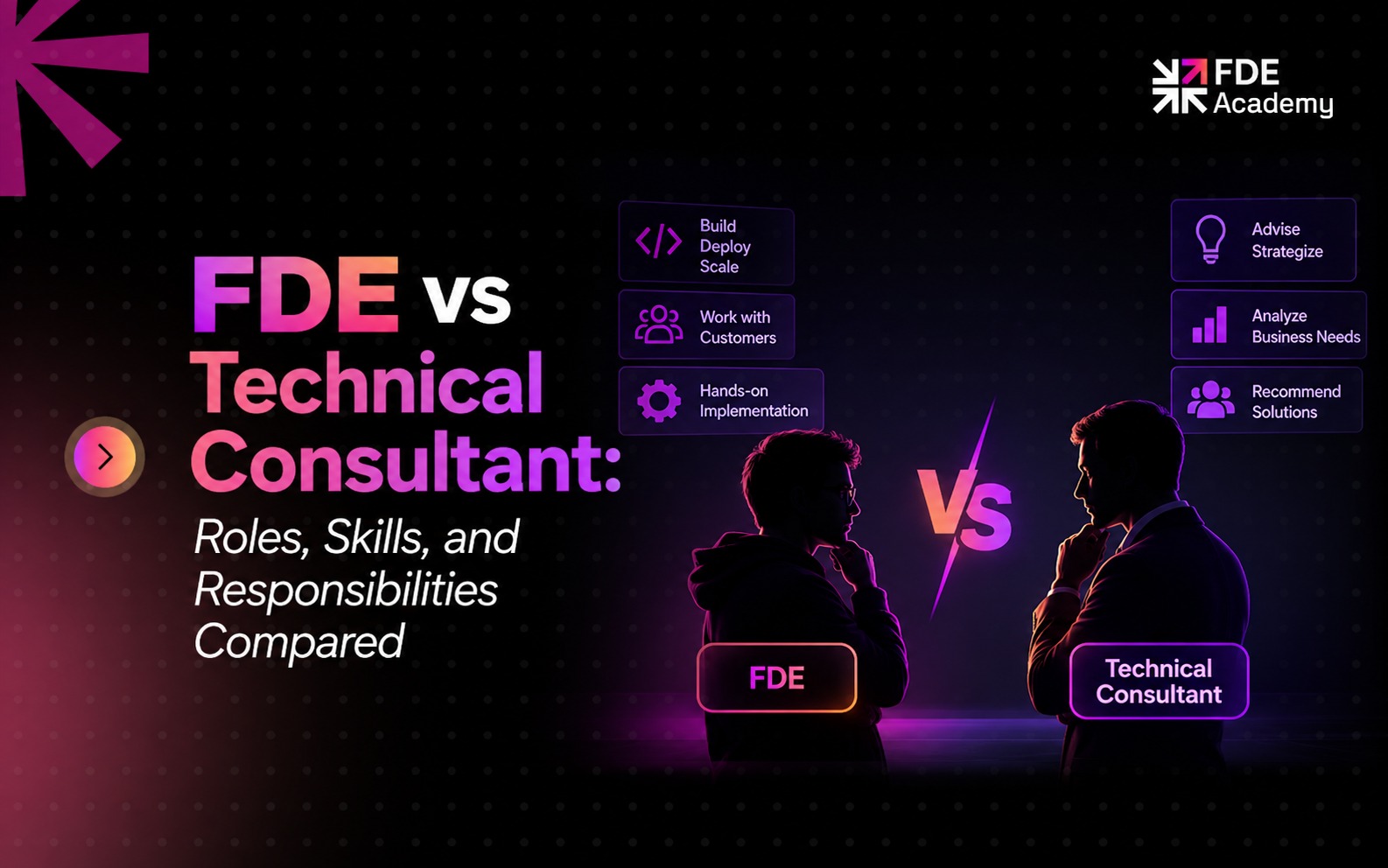
Both roles are post-sale, customer-facing, and technical which is exactly why they blur together in job postings and org charts. FDEs, Solutions Engineers, Sales Engineers, Technical Consultants, and Customer Success Engineers all get confused with each other because every one of these roles involves some level of customer interaction and technical work.
Our broader comparison of how FDEs compare to Solutions Engineers, Sales Engineers, and Customer Success Engineers already flags Technical Consultant as one of the most commonly confused titles in that group. This article is the dedicated deep-dive on that specific comparison.
For the foundational role definition this builds on, see our guide to Forward Deployed Engineer. And if you're specifically weighing FDE against an AI Consultant title rather than a general Technical Consultant, our separate comparison of AI Consultant vs Forward Deployed Engineer covers that more specific pairing.
A Technical Consultant is brought in to analyze a business or technical problem, design a recommended solution or strategy, and guide an organization's decision-making typically handing off implementation to another team rather than building the solution personally.
Technical Consultants guide organizations on deciding technology strategy, solution design, and project execution to meet business goals, and are usually brought in to solve a specific challenge or guide a major digital transformation roadmap.
The engagement model is fundamentally advisory. A consultant advises from the outside and hands off a document the deliverable is a recommendation, a roadmap, or a design, not a running system. This isn't a knock on the value of the role: strategic clarity before a large technical bet is genuinely valuable. It's simply a different kind of value than building the thing itself.
A Forward Deployed Engineer embeds directly inside a customer's environment and writes production code to build, integrate, and deploy a working solution staying accountable through to actual adoption, not just delivery of a design.
A forward deployed engineer is a customer-facing technical role popularized by Palantir, where the engineer works directly with a client to understand their problems and build software solutions in their environment.
The distinction from consulting isn't about seniority or skill level. The distinction between a forward deployed engineer and a traditional software consultant is a matter of operating model where the work happens, what the engineer is accountable for, and how integration and scope change are handled in practice, not a matter of skill level or seniority.
The cleanest framing, echoed consistently across sources: consultants advise, FDEs build. Traditional consulting widens the gap between recommendation and implementation strategy separate from execution, experts separate from the people doing the work while forward-deployed engineers collapse that gap, since strategy emerges from building and recommendations become implementation directly.
This also shows up clearly at the individual-role level, in cases where a company runs both titles side by side under one delivery function. The engineer writes production code, integrations, and data pipelines against the customer's systems, while the consultant defines which problem to solve, redesigns the workflow around what the product can do, and drives adoption small deployments often give both jobs to one person, but at scale the roles separate because the skill sets genuinely differ.
Palantir itself runs exactly this pairing internally: Palantir's consultant-track role, known internally as "Echo," is paired directly with its forward deployed software engineer counterpart, and the substance of the split matches this pattern even though the specifics travel requirements, government-work eligibility, interview format differ by company.
The two models aren't competing for the same job; they answer genuinely different questions, and knowing which one a situation calls for matters more than picking a "better" title. A traditional consulting engagement is the right choice when requirements are well-defined and stable, the integration environment is well-documented and predictable, delivery can be cleanly separated from the operational environment, and the primary risk is budget and timeline rather than adoption and integration complexity.
A forward deployed engineering model is the right choice when requirements will evolve as the build progresses, the integration environment is complex and partially undocumented, and the gap between technical delivery and actual adoption is a known risk.
This distinction matters enormously for AI projects specifically, which is part of why FDE hiring has grown so fast alongside the shift from AI pilots to production. Our analysis of why enterprise AI adoption fails covers this gap in depth and the consultant-vs-FDE choice is directly relevant to it: consultants are the right choice when an organization needs strategy, org design, market analysis, or an executive-level roadmap before committing capital, while FDEs are the right choice once the problem is defined and working software actually needs to exist in production mature enterprises use consultants to frame the bet and FDEs to win it.
The failure mode is buying advice when what was actually needed was delivery of an AI initiative with plenty of strategy and no shipped system leaves an organization with a binder and no product.
A Technical Consultant needs strong analytical and diagnostic skills, the ability to translate business goals into a coherent technology strategy, stakeholder facilitation, and domain expertise deep enough to be credible advising on a major transformation. Technical depth matters, but it supports the recommendation rather than being tested through shipped code.
A Forward Deployed Engineer needs genuine software engineering ability on top of that same business and stakeholder fluency the capacity to write, test, and ship production code against a customer's actual, often messy and undocumented systems. Our full breakdown of the skills an FDE actually needs covers this depth requirement in detail.
The profile that actually succeeds in forward-deployed work is a renaissance generalist deep enough in business to know what's worth solving, deep enough in AI or engineering to build with it, and deep enough technically to know what's possible and hand off cleanly, which is a meaningfully broader bar than pure advisory consulting typically requires.
One underrated distinction: how each role actually learns what's true about a customer's environment. A forward deployed engineer working inside the client's environment integrates against the actual systems, running actual data, and discovers the edge cases before the system is deployed rather than after.
A Technical Consultant, by contrast, typically gathers requirements through interviews, documentation review, and stakeholder workshops, a faster, lower-friction process, but one that can miss the undocumented edge cases that only surface once real integration work begins.
For enterprise AI applications specifically, where a system needs to connect to ERP, CRM, operational databases, and workflow tools simultaneously, this difference in discovery approach has a direct bearing on whether the deployed system works reliably or requires significant post-deployment remediation a concrete, practical reason the FDE model has gained ground specifically for AI delivery work, beyond general preference.
FDE compensation reflects the combination of deep engineering skill and direct production accountability see our full Forward Deployed Engineer salary data for a detailed breakdown. Technical Consultant compensation is harder to benchmark cleanly against FDE roles specifically, since there is no separate, well-established published compensation band for the forward-deployed consultant title yet, meaning any single quoted figure should be treated with caution, and job seekers should read the actual responsibilities in a posting rather than relying on the title alone.
As a general pattern, roles weighted toward production code ownership and delivery accountability the FDE side of this comparison tend to command a premium over advisory-only consulting roles at comparable seniority, though this varies significantly by company and industry.
Choose Technical Consulting if you're energized by diagnosis and strategic clarity figuring out what's actually broken, designing the right path forward, and influencing an organization's direction without necessarily building the solution yourself. It's a strong fit if you prefer engagements with a defined start and end, and less appetite for staying accountable through the messy realities of production deployment.
Choose Forward Deployed Engineering if you want your work measured by whether something actually ships and gets adopted, not by the quality of a recommendation alone. If you're drawn to staying with a problem until it's genuinely solved including the unglamorous edge cases that only show up once real integration begins this is the stronger fit.
Our guide on how to become a Forward Deployed Engineer lays out the concrete path in. And if you're evaluating this at the team or function level rather than the individual-role level, our companion guide to Forward Deployed Engineer vs Professional Services covers how this same advise-vs-build distinction plays out when comparing entire delivery functions rather than individual titles.
A Technical Consultant advises analyzing a problem, designing a recommended solution, and handing it off for someone else to build. A Forward Deployed Engineer builds embedding inside a customer's environment, writing production code, and staying accountable until the system actually works in production.
The clearest summary: a consultant is paid to analyze a problem and deliver recommendations, while an FDE is paid to embed in the organization, write the production code, and ship the working system measured on outcomes shipped, not hours billed.
The world is hiring - and this Academy prepares you for it.