Blogs
Forward Deployed Engineer vs Implementation Engineer: What's the Real Difference?
Forward Deployed Engineer vs Implementation Engineer: What's the Real Difference?
By
R&D, FDE Academy
August 12, 2026

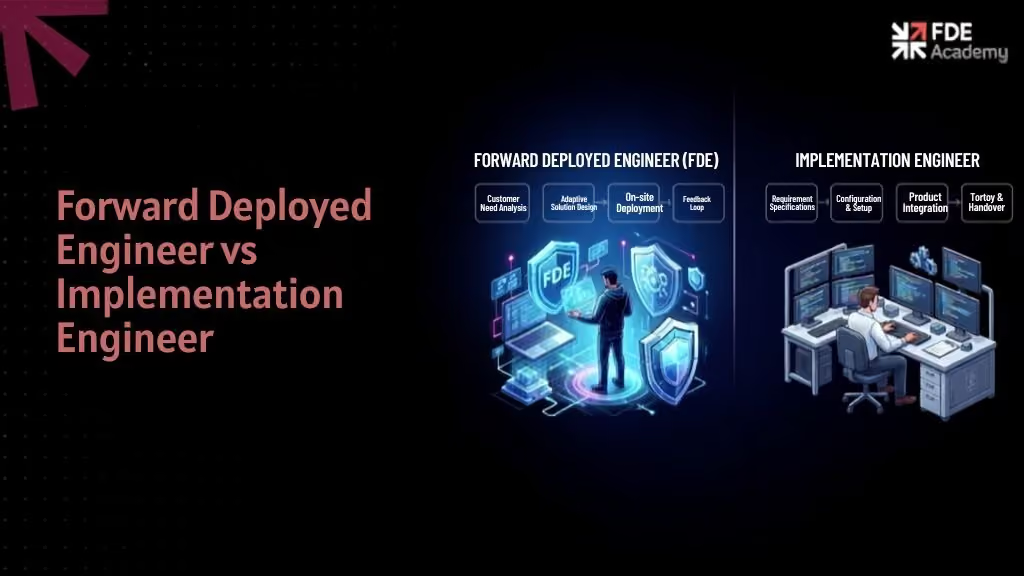
A Forward Deployed Engineer is a technical specialist embedded inside a customer's environment during delivery, responsible for building custom integrations, workflow automation, and client-specific extensions of a product, not just switching on its existing features. FDEs write production code against a specific customer's data, APIs, and workflows, and they stay accountable for whether the deployment actually delivers business value, not just whether it went live on schedule.
The role was pioneered at Palantir and has since been adopted widely at AI-first companies including OpenAI and Anthropic, where deploying a model or platform into a real enterprise environment turns out to require far more engineering than flipping a config switch. For the full breakdown of the role, see our guide on Forward Deployed Engineer fundamentals.
An Implementation Engineer is a technical specialist who deploys, configures, and integrates an already-built software product into a client's business environment using the product's supported configuration options connectors, admin settings, data migration tools, and pre-built integrations.
The role sits between sales and support: once a deal closes, the Implementation Engineer takes over to get the client live on the platform, troubleshoot setup issues, and hand off to ongoing support or customer success.
Implementation Engineers are common across SaaS, enterprise software, and IT services companies. Typical day-to-day work includes running data migrations, configuring integrations (say, connecting a CRM to a marketing platform via documented APIs), writing setup documentation, and working through go-live checklists with the client's IT team.
It's genuinely technical work but it operates inside the boundaries of what the product already supports.
The cleanest way to separate the two: an Implementation Engineer makes an existing product work as designed inside a new environment. A Forward Deployed Engineer makes a product do things it wasn't originally built to do, because the customer's reality doesn't match the product's assumptions.
The forward-deployed engineer builds custom software based on the client's needs, whereas SaaS implementation teams install, configure and customize a core product</cite>. That single distinction build vs. configure is where almost every other difference between the two roles originates: how much code they write, how much ambiguity they tolerate, how they're measured, and what they get paid.
AI vendors such as OpenAI and Anthropic have helped popularize the FDE concept in the past couple of years by leveraging FDE teams to help clients implement their products, though the term and concept trace back to Palantir starting in 2006. Traditional implementation consultants and engineers, by contrast, are a much older function, the delivery layer that's existed as long as enterprise software itself.
It's worth being honest about the overlap, because that's exactly where the two titles get confused in job postings. Both roles are customer-facing and technical. Both work through a discovery phase to understand what the client actually needs which is often different from what the client initially describes.
Both are measured, at least partly, on whether the customer succeeds with the product, not just whether a task got checked off.
Great FDE teams start by working extensively with customers to figure out exactly what they need, assess the client's data readiness early on, and critically transfer knowledge and ownership back to the client before the engagement ends, since FDE teams can't stay embedded forever.
A strong Implementation Engineer follows a similar discovery-to-handoff arc. The difference is what happens in the middle: an Implementation Engineer's toolkit is the product's existing configuration surface, while an FDE's toolkit is a full engineering stack meaning the FDE can solve problems the product literally cannot solve yet.
An Implementation Engineer needs strong product knowledge, comfort with APIs and connectors, solid project and stakeholder management, and the communication skills to translate a client's requirements into a configuration plan.
Certifications in the specific platform (Salesforce, Workday, ServiceNow, and similar) carry real weight here, because the job is fundamentally about depth in one product's configuration surface.
A Forward Deployed Engineer needs all of that plus genuine software engineering ability the capacity to write, test, and ship production code under real deployment constraints, often in an unfamiliar codebase or a customer's messy legacy stack. A software engineer's day centers on implementing features against a spec in a familiar codebase, while an FDE's week might include a customer discovery workshop, a coding marathon for an integration, building a thin frontend for the customer's operators, live incident response, and explaining a technical trade-off to a non-technical stakeholder all in the same week. For the full list, see the skills an FDE needs.
An Implementation Engineer's week is typically structured around a defined rollout plan: configure the environment, migrate data, test integrations against a checklist, train the client's admin users, and move to the next account. The work is repeatable across clients because the product's configuration options are finite and documented.
An FDE's week rarely looks the same twice. Imagine an enterprise implementation stalled for three weeks because the client's stack is messier than the statement of work anticipated, integrations aren't mapping cleanly, and the project manager is fielding escalations she lacks the technical footing to resolve that's the kind of problem an FDE is pulled in to solve, not by following a playbook, but by building a custom fix. For a fuller picture of the role's rhythm, see what forward deployed engineers actually do day-to-day.
Compensation is where the distinction becomes hardest to ignore. Implementation Engineer roles in India pay in a fairly narrow, junior-to-mid band: the average salary for an Implementation Engineer in India is around ₹5.4–6.2 lakh per year, with the typical range running from roughly ₹3.45 lakh to ₹9.5 lakh annually, and top earners reaching around ₹14.9 lakh.
Specialized implementation roles like network or software implementation engineers at larger companies can push somewhat higher, but the ceiling stays well below senior engineering pay.
Forward Deployed Engineer compensation reflects the fact that the role requires full software engineering ability plus customer-facing ownership. India-based FDE roles typically start around ₹18–28 LPA at entry level and can reach ₹60 lakh to over ₹1.5 crore at senior levels, particularly at AI-first companies where FDEs are scarce and in high demand.
See our full Forward Deployed Engineer salary data for a detailed breakdown by experience and company type. The gap isn't arbitrary; it tracks directly with the difference in what each role is trusted to build.
Implementation Engineers are hired broadly across mature SaaS companies, enterprise IT vendors, and systems integrators anywhere a product has a large enough customer base to need a repeatable, documented rollout process. Think CRM platforms, HR systems, network infrastructure vendors, and ERP implementations.
Forward Deployed Engineers are concentrated at companies where the product genuinely can't be "configured" into fitting every customer complex AI platforms, data integration tools, and enterprise software where each customer's environment is different enough that a generic setup wizard won't cut it.
This is why AI-first companies lean so heavily on the model: an LLM-powered platform behaves differently depending on a customer's data, workflows, and existing systems in a way a CRM rollout typically doesn't.
Yes, and it's one of the more common paths into FDE work but it requires closing a real skills gap, not just a title change. Implementation Engineers already have the customer-facing muscle FDE work demands: discovery, stakeholder communication, and the patience to work through a messy environment. What's usually missing is production-grade software engineering depth, the ability to write and ship real code, not just configure existing tools.
The most reliable route is deliberately building that engineering depth while staying close to customer-facing work, rather than trying to become a generalist software engineer first and a customer-facing engineer second.
If you're evaluating that path, our guide on how to become a Forward Deployed Engineer lays out the concrete skill gaps to close, and the closest existing case study transitioning from a solutions engineering background into FDE work maps a similar jump from a configuration-and-relationship-heavy role into one that demands real code.
A Forward Deployed Engineer (FDE) builds and ships custom, production-grade solutions tailored to a customer's specific environment, while an Implementation Engineer configures, integrates, and deploys an existing product using its supported features and tools. FDEs require stronger software engineering skills, handle greater ambiguity, and typically own customer outcomes end-to-end. Implementation Engineers focus more on structured deployment, configuration, and go-live. In short: Implementation Engineers configure; FDEs build, customize, and solve problems the product cannot handle out of the box.
No. A Forward Deployed Engineer writes custom, production-grade code to extend a product for a specific customer's environment, while an Implementation Engineer configures and deploys an existing product using its supported settings and connectors. The FDE role requires full software engineering ability; the Implementation Engineer role does not.
An Implementation Engineer typically runs product setup and configuration, manages data migrations, connects the new system to a client's existing tools via documented APIs or connectors, writes setup documentation, and guides the client's team through go-live. The work follows a largely repeatable playbook across different client accounts.
FDEs are paid more because the role requires production software engineering skill on top of customer-facing work, and because they're accountable for outcomes a configuration-only role can't deliver building custom solutions when the existing product genuinely doesn't fit the customer's environment. In India, FDE roles typically start around ₹18–28 LPA versus roughly ₹3.5–7 LPA for entry-level Implementation Engineer roles.
Yes. Implementation Engineers already have strong customer-facing and discovery skills. The main gap to close is hands-on software engineering ability, which usually requires targeted upskilling rather than a lateral move alone.
Yes. Forward Deployed Engineers write and ship production code as a core part of the job, while Implementation Engineers primarily use a product's existing configuration tools rather than writing new code. This is the single clearest technical distinction between the two roles.
It depends on the starting skill level. Implementation Engineer roles are more accessible for engineers early in their career or coming from IT/support backgrounds, since the role doesn't require deep coding ability. FDE roles typically expect solid software engineering fundamentals already in place, making them a better fit for engineers who already code well and want customer-facing ownership on top of that.
The world is hiring - and this Academy prepares you for it.