Blogs
A Beginner's Guide to Forward Deployed Engineers
A Beginner's Guide to Forward Deployed Engineers
By
R&D, FDE Academy
August 1, 2026

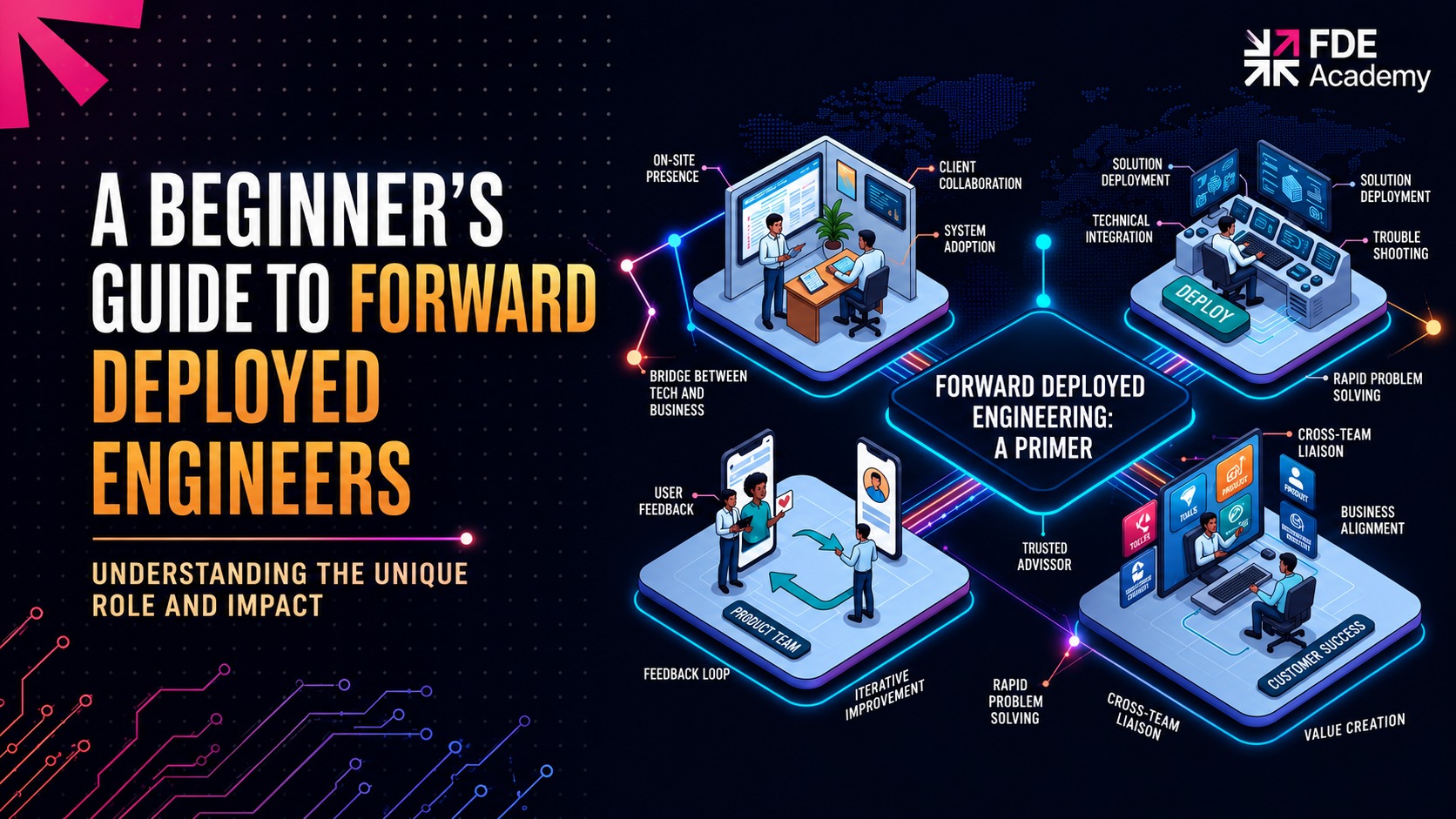
A Forward Deployed Engineer (FDE) is a software engineer who embeds directly inside a customer's organization to build, integrate, and ship a working AI or software system in that customer's real environment, not a demo, the actual production system.
If you're hearing the term for the first time and trying to figure out whether it's a real career path or just a trendy job title, this guide walks through what the role is, what a beginner needs to learn, and how people actually break in.
Strip away the jargon and the definition is simple: an FDE takes a company's product and makes it actually work for one specific customer, inside that customer's messy, real-world constraints, legacy systems, compliance rules, incomplete data, teams who've never used the tool before.
That's different from a typical software engineer, who usually builds one version of a product for thousands of customers at once. An FDE builds and adapts a working system for a single customer, sitting close enough to that customer's team to see exactly where the product breaks down in practice.
Wikipedia's definition captures the formal version well: it describes a Forward Deployed Engineer as someone who works closely with a client organization to build, adapt, and deploy technical solutions inside real operational settings, pairing hands-on development with a close working relationship with the people who'll actually use the system.
In 2026, most of that work happens on AI systems RAG pipelines, agents, and LLM integrations but the underlying job pattern predates the AI boom by well over a decade.
For the fuller version of this definition, including how it's evolved company by company, see our full breakdown of the Forward Deployed Engineer role.
The FDE title was coined at Palantir around 2009. Palantir built software for government and intelligence customers who couldn't openly share requirements so instead of a traditional sales-and-support model, Palantir embedded cleared engineers directly at customer sites, internally nicknamed "Deltas." For a stretch until 2016, Palantir employed more FDEs than traditional software engineers.
The model stayed a Palantir-specific quirk for over a decade. Then AI happened. Companies like OpenAI, Anthropic, Databricks, and Salesforce ran into the exact same problem Palantir had solved years earlier: a powerful AI product doesn't sell itself into production someone has to sit with the customer, understand their data and workflows, and build the thing that actually gets adopted.
FDE hiring reflects that shift sharply. Job postings for the role grew roughly 729% year-on-year through mid-2026, according to Indeed data reported via Times of India.
A beginner's mental model should look something like this, in rough order across a typical engagement:
This loop discovers, prototype, validate, ship, iterate and repeat continuously, sometimes multiple times a week on a fast-moving engagement. For the granular, hour-by-hour version, read a full day in the life of a Forward Deployed Engineer.
Beginners almost always confuse FDE with one of two adjacent titles. Here's the quick distinction:
The one-line version: a Software Engineer builds for everyone, a Solutions Engineer sells the vision, and a Forward Deployed Engineer builds the thing that actually ships for this customer. For a deeper comparison, see Forward Deployed Engineer vs Software Engineer.
You don't need a research-lab background to start down this path. What you do need falls into four clusters:
Most beginners already have piece one from a CS degree or bootcamp. The gap is usually pieces two through four and that gap is exactly what structured FDE programs are built to close. For the complete skills breakdown, including how to demonstrate each one in an interview, see the complete skills breakdown.
A few misconceptions trip up almost every beginner researching this role:
Myth: "FDE is just prompt engineering." Prompt engineering might be one small piece of the toolkit on an AI-heavy engagement, but the actual job is systems integration, production debugging, and stakeholder management prompting a model is the easy 10%.
Myth: "You need a machine learning PhD." Most FDEs come from backend engineering, DevOps, or solutions architecture backgrounds, not ML research. You need to understand what a model can and can't reliably do not build one from scratch.
Myth: "It's basically consulting." FDEs write and ship real production code. Consultants hand over a strategy deck and leave. That distinction is the entire point of the "engineer" half of the title.
Myth: "It's only for senior engineers." Most companies do prefer 2+ years of engineering experience because customer-facing accountability is hard to hand to someone with zero production experience but that's a floor, not a ceiling. Freshers with one solid, real production project on their resume have a real shot.
Compensation varies widely by geography and company, but here's a realistic beginner-level picture for 2026.
FDE pay sits meaningfully above typical entry-level software engineering pay because the talent pool is small and the role connects directly to customer retention, an outcome leadership can see clearly, unlike a lot of internal engineering work. For the full breakdown by city, company tier, and seniority, see the Forward Deployed Engineer salary guide.
If you're convinced this path is worth pursuing, the practical starting sequence looks like this:
For a step-by-step roadmap with timelines, read how to become a Forward Deployed Engineer. If you're a recent graduate specifically, how fresh graduates break into Forward Deployed Engineering covers the fresher-specific path in more depth. And if you're still weighing whether this is the right move at all, see whether Forward Deployed Engineering is a good career choice.
A Forward Deployed Engineer is a software engineer who works directly inside a customer's organization to build and ship a working version of a product for that specific customer, rather than building one version for every customer from headquarters.
A CS degree helps but isn't mandatory. What matters more is demonstrated engineering ability in a real production project, comfort with systems integration, and the communication skills to work directly with customers.
A software engineer typically builds one version of a product for many customers at once. A Forward Deployed Engineer adapts and ships that product for one specific customer, embedded in that customer's actual environment and constraints.
It's a strong path for beginners who already have solid engineering fundamentals and want faster exposure to real production systems and customer-facing work, though most companies prefer at least some hands-on project experience over a completely blank resume.
Start with systems integration APIs, authentication, and working with enterprise data formats alongside enough applied AI knowledge (RAG, agents, LLM basics) to build with modern tools, and practice communicating technical tradeoffs clearly.
Entry-level Forward Deployed Engineers in India typically earn around ₹18–28 LPA, noticeably higher than typical entry-level software engineering compensation, reflecting the smaller talent pool and the role's direct connection to customer outcomes.
The world is hiring - and this Academy prepares you for it.