Blogs
FDE vs Data Scientist: Who Does What in Enterprise AI?
FDE vs Data Scientist: Who Does What in Enterprise AI?
By
FDE Academy Editorial Team
May 11, 2026

A Forward Deployed Engineer (FDE) and a Data Scientist both operate inside enterprise AI — but they own completely different stages of it. A data scientist answers "what does the data tell us?" An FDE answers "how do we make this AI system actually work inside a customer's environment?"
In enterprise AI, a Data Scientist turns raw data into models and insights. A Forward Deployed Engineer takes those models and turns them into running production systems inside a specific customer's environment. An FDE is to deployment what a Data Scientist is to analysis — and the gap between those two functions is exactly where most enterprise AI projects stall.
Confusing these roles is one of the most common reasons enterprise AI deployments fail between a promising proof-of-concept and a live production system. This guide draws a clear line.
A Data Scientist uses data, statistics, and machine learning to answer business and technical questions.
In an enterprise AI environment, a Data Scientist may be responsible for:
A typical Data Scientist technology stack may include Python, SQL, pandas, scikit-learn, Jupyter, statistical libraries, cloud data platforms, and business intelligence tools.
The role varies significantly between companies. Some Data Scientists are heavily involved in machine learning engineering and production deployment, while others focus primarily on experimentation, analytics, and business insights.
The common thread is that Data Scientists primarily use data and analytical methods to understand problems, test hypotheses, and develop models or insights that support decisions.
A Forward Deployed Engineer is a customer-embedded engineer who owns AI deployment end-to-end inside a specific client's environment. Where the data scientist's work ends a validated model, a proof-of-concept the FDE's work begins.
The FDE role combines software engineering, systems thinking, and direct customer collaboration in a way that no traditional role does. As Leo Mehr, Head of Forward Deployed Engineering at fintech scaleup Ramp, describes it: "FDE responsibilities look similar to those of a startup CTO you'll work in small teams and own end-to-end execution of high-stakes projects."
In practice, an FDE's work follows a repeating iteration cycle: Discovery → Prototype → Validate → Ship → Iterate. They scope the real technical problem with the customer, build a working prototype fast, validate it against actual user workflows, ship it to production, and own what happens next. They write production code, manage integrations with legacy systems, handle enterprise auth (SSO, SAML, OIDC), navigate security requirements, and feed field learnings back to the core product team.
Palantir the company that invented the FDE model in the early 2010s built its entire go-to-market around this role, calling FDEs "Deltas." Today, companies including OpenAI, Anthropic, Cohere, Databricks, and a wave of AI-first startups hire FDEs because the hardest part of enterprise AI is no longer building a model. It is getting that model to run reliably, securely, and usefully inside a real customer environment. To understand more about what a forward deployed engineer is in full detail, our cornerstone guide covers the role from the ground up.
The biggest difference between a Forward Deployed Engineer (FDE) and a Data Scientist is the type of problem they primarily solve. A Data Scientist focuses on using data, statistics, and machine learning to understand problems, test hypotheses, and develop models or insights.
An FDE focuses on turning technology into a working solution for a real customer or business environment, which can involve technical discovery, software development, system design, integrations, deployment, and ongoing iteration.
The roles can overlap Data Scientists may work on production models, while FDEs may analyze data but their primary focus and expected outcomes are usually different.
Consider a mid-sized financial services firm that hired a data science team to build an internal AI assistant. The models were solid validated in notebooks, strong accuracy metrics, signed off by the chief data officer. Then the deployment phase began.
The system needed to connect to the firm's on-premise data warehouse running a legacy Oracle setup. It needed to authenticate via the firm's SAML-based SSO. It needed to pass an internal security audit before going anywhere near production. It needed to run reliably under concurrent load from 400 users across three regional offices.
The data scientists had built exactly what they were asked to build. But none of what came next was in their job description. The project sat in "pre-deployment" for seven months.
This is the problem FDEs are hired to solve. An FDE embedded with this client would have scoped the integration wall on day one, built a working prototype against the legacy data layer in week two, navigated the SSO and security requirements in parallel, and shipped a live system in six to eight weeks. The data scientists' model would have reached production. The business value would have landed.
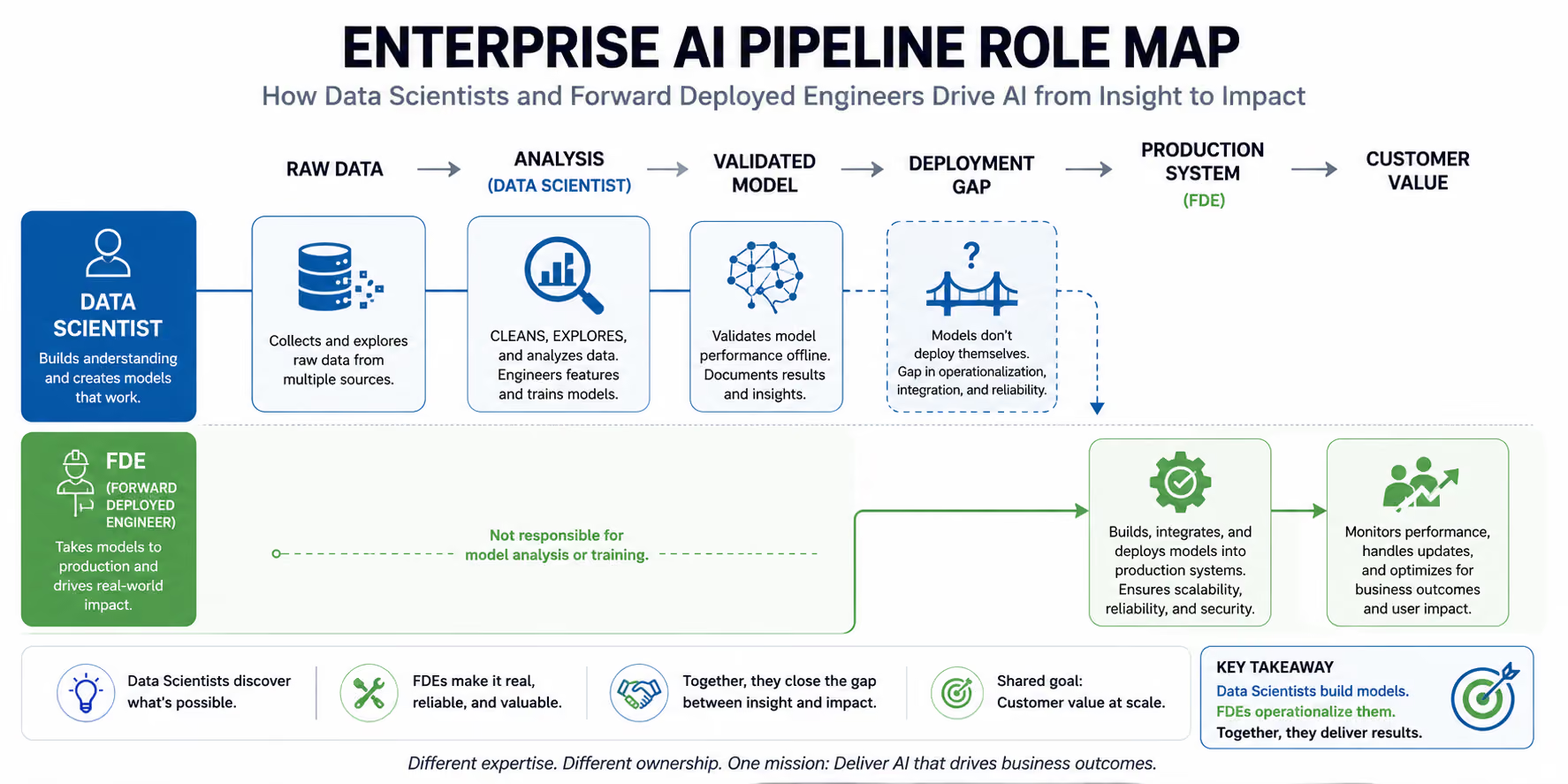
The cleanest distinction: a data scientist's output is knowledge. An FDE's output is a running system.
Data scientists answer "what is true?" and "what is likely?" FDEs answer "how do we ship this?" and "why isn't this working in production?" These are not better or worse questions they are different in kind. A model that never gets deployed delivers no business value. A deployed system built without good data science is unreliable or wrong. Healthy enterprise AI teams need both functions.
The blur happens at scale. At smaller companies, a data scientist may be expected to deploy their own models, and an FDE may do exploratory analysis before scoping a solution. As companies scale, these functions separate and the confusion about who owns what is exactly what leads to 18-month AI projects that never reach production.
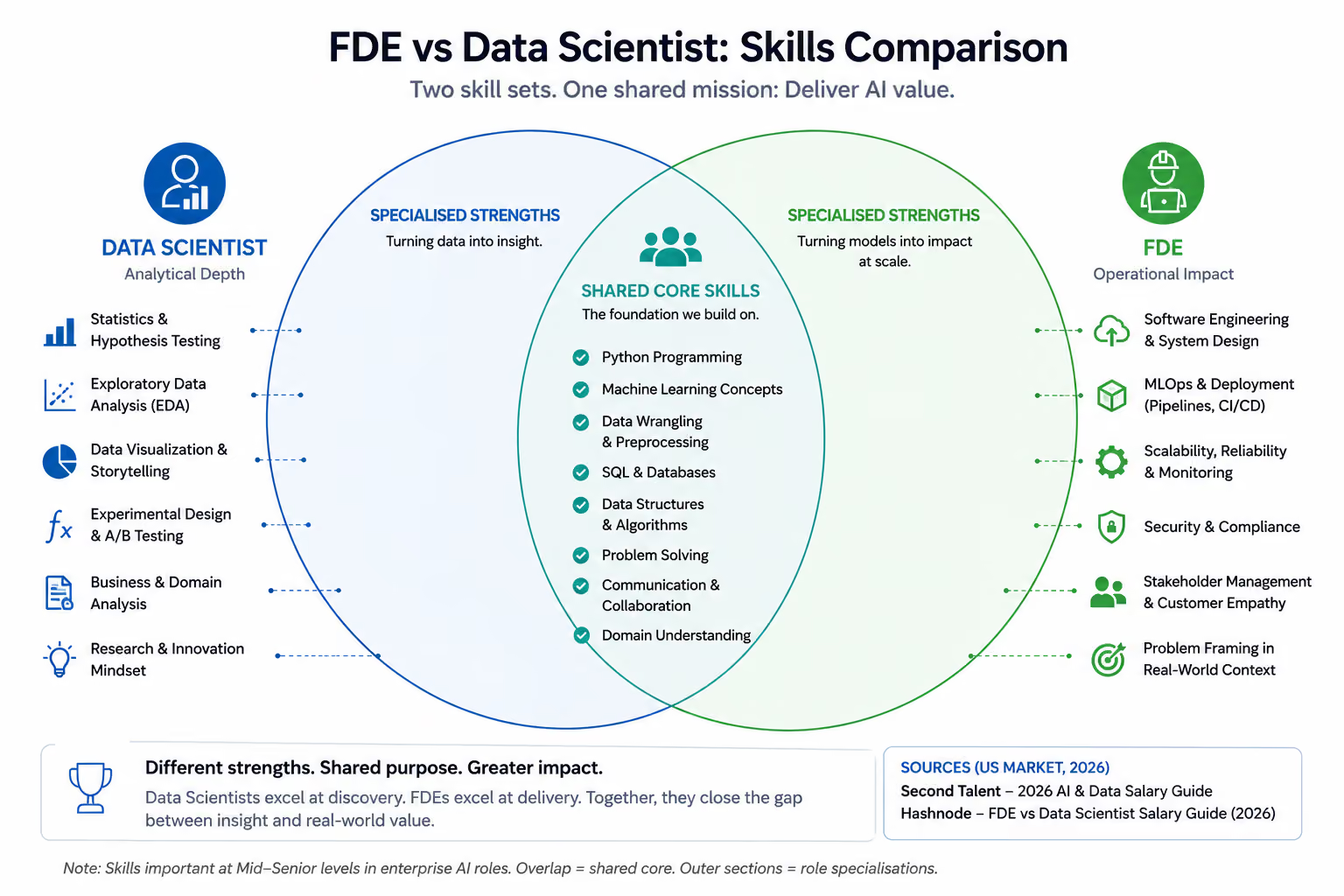
Both roles require strong Python, comfort with ML concepts, and the ability to work with messy data. That is roughly where the overlap ends.
The table below reflects the core capability split, not the occasional exception. A senior data scientist who cannot deploy to production is not failing; they are doing exactly the right job. A senior FDE who cannot navigate enterprise SSO while debugging a RAG pipeline is underperforming.
Data scientists are optimised for depth of analysis. FDEs are optimised for breadth of execution. Both are genuinely hard skills — they simply point in different directions. See our FDE skills guide for a deeper breakdown of the full FDE competency stack.
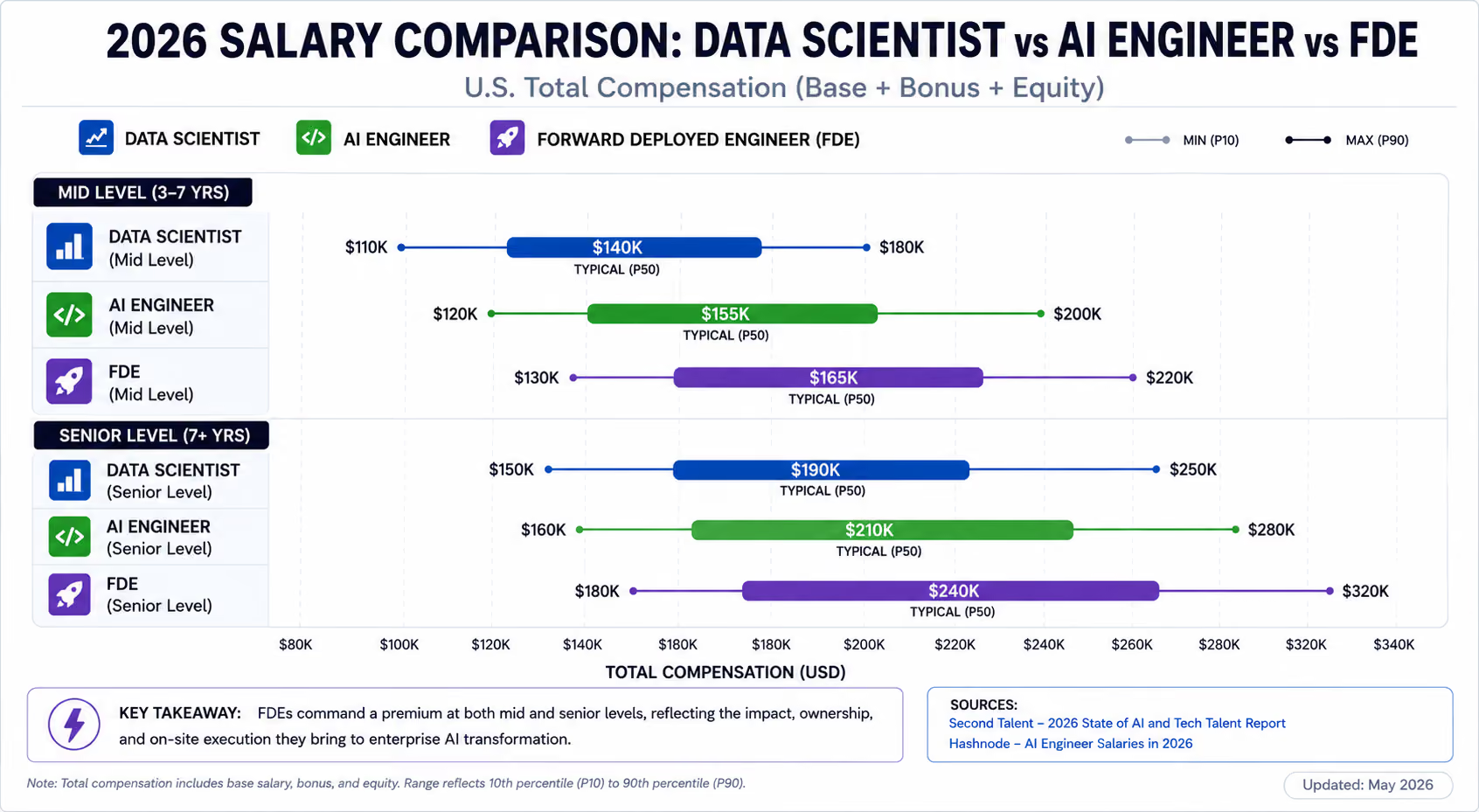
Production skills carry a significant pay premium in the 2026 market, and that premium compounds sharply at the FDE seniority level. The table below draws from the Second Talent AI Salary Index Q1 2026, the ODSC salary analysis, and the Hashnode FDE Guide 2026.
The FDE premium exists for one specific reason: skill scarcity. You need strong software engineering and high-empathy customer communication and the ability to own a multi-million dollar enterprise relationship simultaneously. That combination is rare, and forward deployed engineer salary data confirms the market knows it.
For Indian professionals: FDE roles at global companies with remote-first structures are increasingly accessible. Base salaries in India-based FDE roles at well-funded AI startups range from ₹25–50 LPA at mid-level. Senior and staff-level positions at global companies are often structured as US-equivalent total compensation packages, especially for roles supporting North American or European clients.
These roles are not interchangeable, and hiring the wrong one for the problem wastes time and money.
Hire a data scientist when:
Hire a forward deployed engineer when:
You need both when:
See top companies hiring FDEs for a sense of which enterprise AI organisations have committed to the FDE model at scale.
Yes, and the data is unusually clear on this. FDE job postings grew over 800% between 2024 and 2025, per Futurense's hiring market analysis, driven by enterprise adoption of AI platforms that require specialised deployment expertise. It is the fastest-growing distinct engineering role in the market right now.
The structural reason: every AI lab selling to enterprises Palantir, OpenAI, Anthropic, Cohere, Databricks needs engineers who can own the customer-side deployment problem. That demand is not going away as AI matures; it grows with the complexity and volume of AI rollouts. There are not enough qualified FDEs in the market. Supply has not caught up with the explosion in postings.
The compensation, the ownership, and the demand signal all point the same way. For a technical professional who wants to work at the intersection of engineering and real-world customer impact rather than purely internal R&D FDE is one of the highest-ROI career pivots available right now.
If you want a full breakdown of the trajectory, FDE vs software engineer is worth reading alongside this article for the broader career positioning picture.
Yes, and it is one of the more natural transitions in AI careers, with a specific and well-defined skill gap to close. Data scientists already have the analytical rigour, the comfort with messy data, and the ML conceptual foundation that FDE work draws on. What they typically need to build is the production-engineering side: shipping code to real systems, handling enterprise infrastructure, and developing the customer-facing communication muscle that FDE work demands daily.
The transition tends to go faster for data scientists who have already done model deployment, MLOps, or technical client-facing work. The jump from notebook-based analysis to owning a production AI deployment inside a Fortune 500 environment is real but it is a well-defined skill gap, not an insurmountable one.
How to become a forward deployed engineer maps out the specific competencies and a structured path to close that gap.
Thinking about the transition? FDE Academy's PGP in Forward Deployed Engineering & Applied AI Solutions is the only structured 8-month program built specifically for this path, developed by practising FDEs. It covers the full production-to-customer skill stack from enterprise integrations and RAG architecture to customer scoping and deployment ownership. 60 selective seats per cohort. Optional IIT Roorkee certification extension.
Data Scientists build models and extract insights; Forward Deployed Engineers (FDEs) turn those models into reliable, production-ready AI systems inside real customer environments. Data Scientists focus on analysis, experimentation, and model development, while FDEs focus on deployment, integrations, security, infrastructure, and customer outcomes.
In 2026, FDEs are increasingly in demand as enterprises move from AI prototypes to production. The roles complement each other: Data Scientists answer “What does the data tell us?” while FDEs answer “How do we make this work in production?” Data Scientists can also transition into FDE roles by strengthening their software engineering, cloud, enterprise integration, and customer-facing skills.
In enterprise AI, a Data Scientist turns data into models and insights, while a Forward Deployed Engineer turns those models into running production systems inside a customer's environment. The data scientist's primary output is knowledge — insight, forecasts, validated models. The FDE's primary output is a deployed, running system. Both roles are essential; neither replaces the other. The breakdown between them is typically the single biggest cause of enterprise AI projects stalling before reaching production.
FDEs need working knowledge of data science enough to evaluate model quality, understand training data constraints, and scope what is technically feasible with an AI system. They do not need the statistical depth of a dedicated data scientist. The core FDE skill set centres on production engineering, enterprise system integrations, cloud infrastructure, and customer-facing problem-solving. The two roles complement each other rather than overlap deeply.
Forward deployed engineers command significantly higher total compensation in 2026. US data scientists at senior level earn $160K–$225K. Senior FDEs at Palantir average $238K total comp, with OpenAI and Anthropic FDE packages typically in the $350K–$550K range, according to the Hashnode 2026 FDE guide and Second Talent's Q1 2026 salary index. The premium reflects the combination of production engineering depth and high-ownership customer relationship management that the FDE role demands simultaneously.
Yes, and it is one of the most common FDE career entry points. Data scientists already have strong ML fundamentals, Python skills, and experience working with complex data — all of which carry over directly. The skill gap to close is primarily on the engineering side: production infrastructure, enterprise integrations, CI/CD pipelines, and cloud systems. Equally important is building the customer-facing communication and project ownership that FDE work requires daily. Both gaps are closeable through structured training and hands-on deployment experience.
FDEs typically integrate and deploy existing models rather than train new ones from scratch. At companies like Palantir, OpenAI, and Anthropic, FDEs work with the platform's core models and build the surrounding systems — enterprise integrations, data pipelines, RAG architectures, agentic workflows, authentication layers — that make those models usable inside a specific customer environment. They write real production code throughout, but the model research and training usually sit with a separate team.
Hire an FDE when the core problem is deployment, not analysis. If your AI product is stuck between a working demo and a live enterprise implementation, or if customers are churning or stalling because AI systems are not going live, an FDE is the right hire. If you need to understand what your data is telling you, validate a modelling approach, or build predictive analytics infrastructure, that is a data science problem. Many high-performing enterprise AI teams run both roles in parallel, with data scientists feeding validated models to FDEs who own the production path.
The world is hiring - and this Academy prepares you for it.