Blogs
Does Salesforce Hire Forward Deployed Engineers?
Does Salesforce Hire Forward Deployed Engineers?
By
R&D, FDE Academy
August 29, 2026

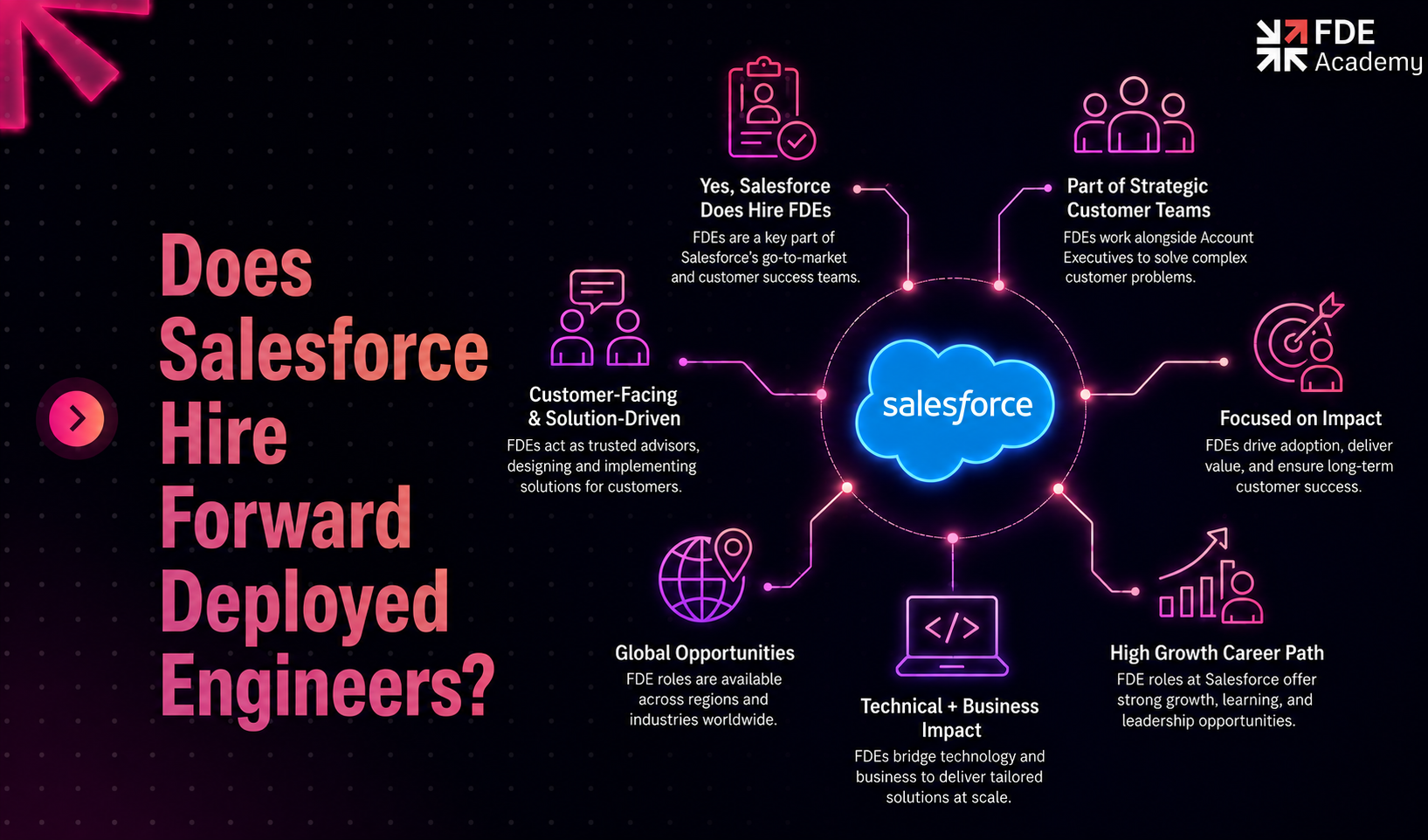
Yes, Salesforce actively hires Forward Deployed Engineers. The role sits inside Salesforce's Agentforce organization, embedding engineers directly with enterprise customers for roughly three-month engagements to design, build, and ship custom AI agents into production. The program launched in April 2025, tripled in size within six months, and as of mid-2026 has 20 or more live openings spread across four continents, spanning new-grad through principal level.
A Salesforce Forward Deployed Engineer is embedded, full-time, with a single enterprise customer, personally writing the code that turns Agentforce's platform capabilities into a working, production-grade AI agent for that specific business. This isn't a support or implementation role in the traditional sense; FDEs sit at the intersection of customer engagement and platform engineering, designing automated business process solutions, which Salesforce internally calls "Blueprints," and owning them from discovery through launch and iteration.
For the general definition of this role across the industry, see Forward Deployed Engineer. Salesforce's version follows the same core pattern popularized by Palantir, embed with the customer, build against real constraints, ship fast, but applied specifically to Agentforce deployments rather than a generalized data platform.
Understanding what this role actually produces helps clarify why Salesforce built a dedicated engineering function around it rather than leaving deployment to existing solutions consultants. At Dreamforce 2025, Salesforce showcased several customer deployments built with FDE involvement:
These aren't abstract case studies; they're the kind of production deployment an individual FDE pod is responsible for shipping within a single roughly three-month customer engagement. That timeline, going from a customer's specific business problem to a live, production agent in about a quarter, is the clearest illustration of what "forward deployed" actually means in practice at Salesforce, and why the role demands both technical speed and customer-facing judgment in the same person rather than splitting those skills across separate teams.
Salesforce's FDE program exists because of a gap between AI pilots and AI production. At Dreamforce 2025, Salesforce reported that Agentforce had reached over 12,500 deals since its launch roughly three quarters earlier, with a 60% quarter-over-quarter increase in customers moving from pilot to production. Getting customers from a proof-of-concept demo to a scaled, production deployment turned out to be the actual bottleneck, and Salesforce's President and Chief Engineering & Customer Success Officer, Srinivas Tallapragada, described the company's approach as working with customers using forward deployed engineers specifically to scale those pilots, with a tight, closed feedback loop back into the product.
Marc Benioff has framed the role prominently in Salesforce's own public messaging around the AI adoption gap, and Salesforce brands the FDE role as one of the company's most in-demand positions internally. This pattern, where an AI platform company creates a forward-deployed function specifically to close the gap between demo and production, mirrors why other AI-native companies have built similar programs. For more on that broader trend, see why companies are hiring Forward Deployed Engineers.
Salesforce's officially posted base salary bands for Forward Deployed Engineer roles run from roughly $143,000 to $384,000, varying by level and location; New York-based roles span roughly $158,000 to $384,000 across levels, and Massachusetts-based roles roughly $143,000 to $352,000. Third-party total compensation estimates, including equity, put the overall package in the $200,000 to $400,000 range.
Where Salesforce lands within the broader FDE market depends on which company you're comparing it to; some AI-native startups pay more at senior levels, while Salesforce's program stands out for spanning entry-level through principal rather than restricting itself to experienced hires only. For a fuller picture of how compensation varies across the FDE landscape, see Forward Deployed Engineer salary data.
Salesforce's FDE interview loop runs in four stages:
The customer-facing rounds, not the coding round, are typically what decide whether an offer gets extended. This tracks with how the role is actually structured: an FDE who can code well but struggles to navigate ambiguous customer requirements or communicate technical trade-offs to non-technical stakeholders will struggle in the actual job, regardless of how the technical round goes. For a broader set of practice questions covering this style of interview, see Forward Deployed Engineer interview questions, and for a structured walkthrough of building an application from resume through final round, see the Forward Deployed Engineer resume, portfolio, and interview guide.
Yes, and this is one of the more distinctive features of Salesforce's program. Most companies restrict FDE hiring to experienced engineers, since the role demands both technical depth and customer-facing judgment that typically comes with years on the job. Salesforce instead built a real early-career path into the role through its Futureforce program, with new-grad FDEs onboarding through "Ready in Six," a structured six-week bootcamp that culminates in a field capstone project before new hires are embedded with a live customer.
This matters for anyone early in their career considering the FDE path generally, not just at Salesforce. If you're weighing whether forward deployed engineering is realistic without years of prior experience, see how fresh graduates can break into Forward Deployed Engineering for the broader picture across the industry, since most programs outside Salesforce's do expect more seasoning before considering a candidate.
Salesforce is one of a growing list of companies running forward deployed engineering programs, and it's worth understanding where it sits relative to the others rather than evaluating it in isolation.
The core skill set, technical building ability paired with customer-facing judgment under ambiguity, transfers across nearly all of these programs, which is why comparing them side by side is useful even if you're only interested in one. For the fuller landscape of which companies are hiring for this role right now, see top companies hiring Forward Deployed Engineers.
Four areas show up consistently across what Salesforce's interview loop actually tests for:
These map closely to the general FDE skill set the industry expects. See the core skills every FDE needs for the fuller breakdown that applies beyond Salesforce specifically.
If you're targeting this role specifically, a few steps make the difference between a generic application and one that reflects real preparation:
This role fits people who want deployment-facing AI work with real customer stakes, not a research role or a purely internal engineering position. It suits candidates comfortable with a three-month rotation cadence and genuinely energized by learning a new customer's environment repeatedly, rather than those who prefer deep, long-term ownership of a single system.
It's a strong fit if you're weighing Salesforce specifically against other FDE programs and want one of the few paths into this career track that doesn't require years of prior experience first. If you're still deciding whether forward deployed engineering as a career, at Salesforce or elsewhere, is the right direction, the Forward Deployed Engineering & Applied AI Solutions program is built to prepare engineers for exactly this kind of deployment-facing AI work, with a Learn, Apply, Build loop designed around the same skills Salesforce and comparable companies actually screen for.
Deployment failure means a system never reaches a working, production state, often due to data quality, integration, or sponsorship issues. Adoption failure means the system technically works and is live, but the intended users don't actually rely on it in their daily work.
Most commonly through quiet abandonment: the tool doesn't fit their actual workflow closely enough, an early mistake damaged trust, or the friction of using it outweighs the benefit compared to their previous process, not dramatic resistance or explicit rejection.
Shadow AI refers to employees informally using consumer AI tools like ChatGPT instead of a company's sanctioned enterprise system. Its persistence after an official tool launches is one of the clearest signals that the sanctioned tool hasn't achieved genuine adoption, and it often reveals what the tool should have been designed to do.
By designing around real, observed workflows rather than idealized ones, building user trust incrementally through staged rollouts, and staying engaged well past the technical go-live date to iterate based on actual usage patterns rather than treating launch as the finish line.
Not usually. Persistently low usage is more often a signal that the tool doesn't genuinely fit how people work, a design problem worth revisiting, rather than a knowledge gap that more training alone will fix.
Our why AI projects fail guide covers the much larger share of AI initiatives that never reach production at all. This piece focuses specifically on the smaller, quieter failure mode: systems that do reach production but still fail because they were never genuinely adopted.
The world is hiring - and this Academy prepares you for it.