Blogs
FDE vs MLOps Engineer 2026: Salary, Skills & Career Path
FDE vs MLOps Engineer 2026: Salary, Skills & Career Path
By
FDE Academy Editorial Team
May 12, 2026

A Forward Deployed Engineer (FDE) and an MLOps Engineer are both roles that move AI from development into production — but they own completely different parts of that problem. An FDE deploys AI directly inside a customer's environment, owns the business outcome end-to-end, and bridges engineering with client collaboration. An MLOps engineer builds and maintains the internal infrastructure — pipelines, monitoring, feature stores — that makes machine learning systems reliable and scalable for the wider engineering organization.
Understanding the distinction is what helps you target the right career, ask for the right salary, and build the right skill set in 2026.
To understand what a Forward Deployed Engineer is, start with the core premise: FDEs are the engineers who go where the problem lives.
Rather than building internal tooling, an FDE embeds with a specific customer — an enterprise, a healthcare system, a financial institution — and takes an AI product from prototype to working deployment inside that customer's real environment. The canonical work cycle is: Discover → Prototype → Validate → Ship → Iterate. FDEs run that cycle in full, inside a live customer environment with real constraints, real users, and real accountability.
The role was pioneered at Palantir, where engineers were placed on-site with clients including the U.S. Department of Defense, BP, and global financial institutions to deploy data platforms in production. OpenAI and Anthropic later built FDE teams to support enterprise AI deployments. Today the model has spread across AI-first SaaS, fintech, healthtech, BFSI, and consulting firms worldwide.
What makes FDE distinct from other AI roles is the dual accountability: FDEs are technically deep enough to build, and commercially aware enough to own outcomes. They translate ambiguous business problems into engineering specs, ship prototypes in days not months, and are accountable for whether the AI deployment actually changed something for the customer — not just whether it technically worked.
The FDE role is often described as a "customer-facing AI deployment engineer" — which captures the external orientation, but understates the engineering depth required.
An MLOps engineer operates on the infrastructure side of the AI lifecycle. Their job is to make machine learning reliable at scale — primarily for their own organization's data science and ML teams, not for external customers.
The scope is broad and requires deep specialization. MLOps engineers:
Put simply: MLOps engineers build the platform that lets ML engineers ship faster. They are infrastructure engineers who speak machine learning fluently.
The role emerged because getting ML models into production is dramatically harder than training them. One widely cited industry analysis found that 87% of data science projects never reach production — MLOps engineering exists to close that gap.
As a career path, MLOps has a well-established tooling ecosystem, a strong practitioner community, and clear seniority ladders. It's an inward-facing discipline: the primary "customer" is the internal data science or ML team.
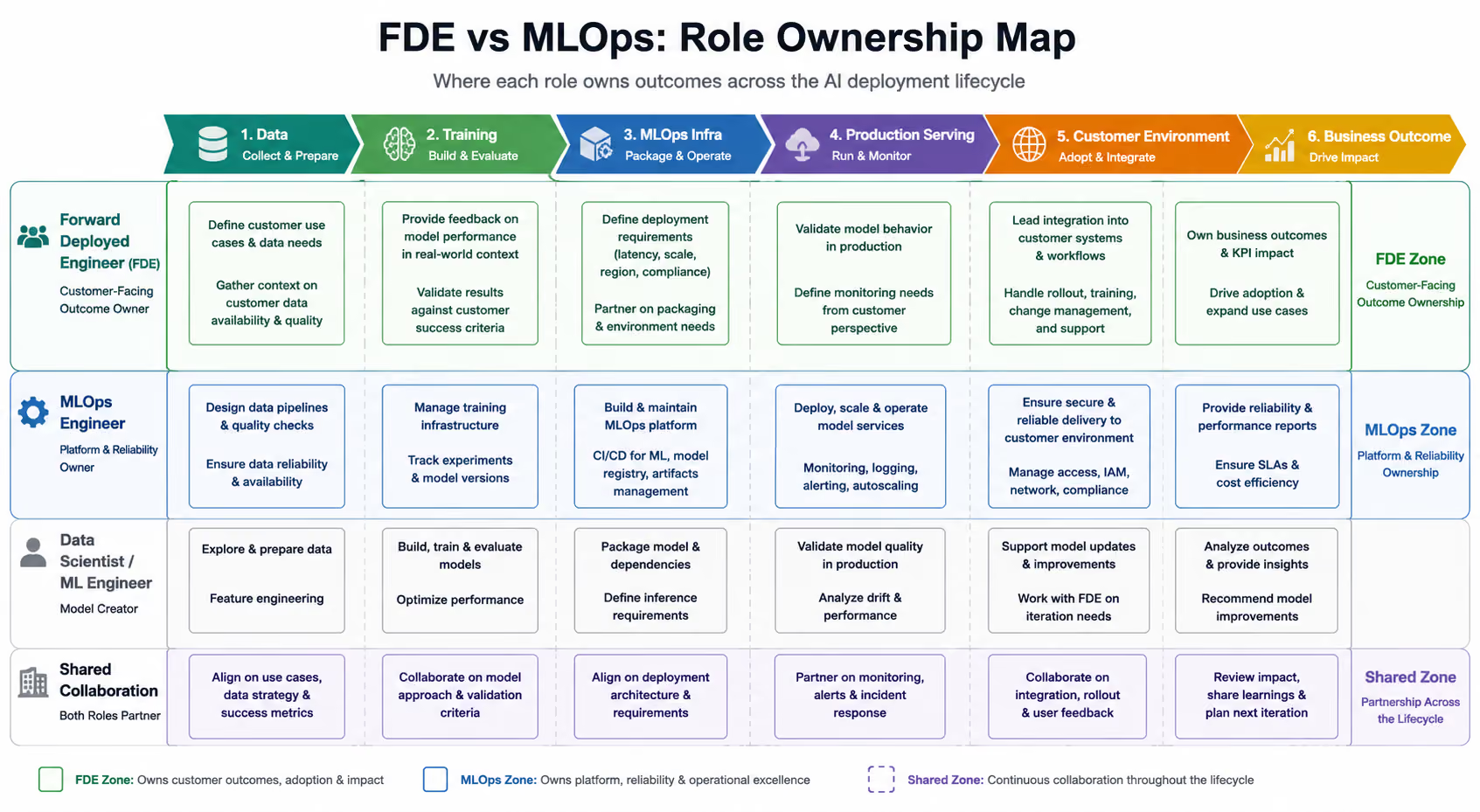
This is the clearest line between the two roles, and worth stating precisely before comparing anything else.
An MLOps engineer asks: "How do we make our ML pipeline reliable, scalable, and reproducible for our engineering organization?"
A Forward Deployed Engineer asks: "How do we make this AI product actually work in the customer's environment — and how do we prove it's creating business value?"
MLOps is an inward-facing discipline. Success is measured in infrastructure uptime, pipeline latency, deployment frequency, and model monitoring coverage.
FDE is an outward-facing discipline. Success is measured by whether the AI deployment changed something meaningful in a real customer organization — whether it saved time, reduced cost, improved a decision, or generated revenue.
An FDE will use MLOps tooling but doesn't build or own the platform. They consume it. The distinction mirrors the relationship between a DevOps engineer (who builds the release pipeline) and a software engineer (who ships features through it) — just at a more advanced level of AI deployment.
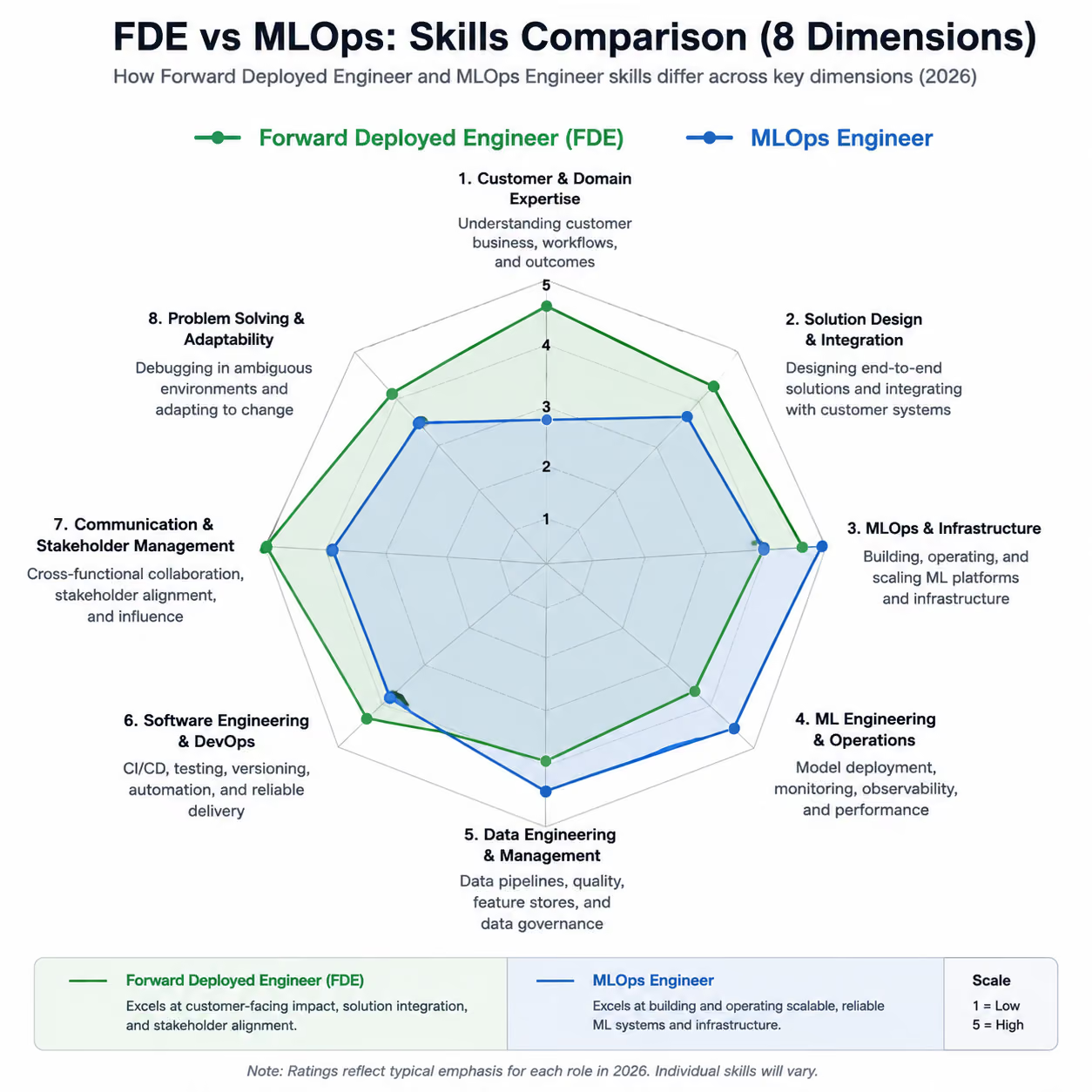
The technical foundation is shared. Both roles require Python, cloud infrastructure (AWS/GCP/Azure), containerization with Docker and Kubernetes, API integration, and a solid understanding of how ML models behave in production. Neither is an entry-level role — both expect demonstrated production experience.
The divergence starts above the technical foundation.
The practical read: MLOps engineers go deeper on infrastructure tooling. FDEs go broader — combining engineering, communication, and business judgment in ways that MLOps roles rarely demand.
See the full FDE skill breakdown and the tools FDEs work with for a detailed technical picture.
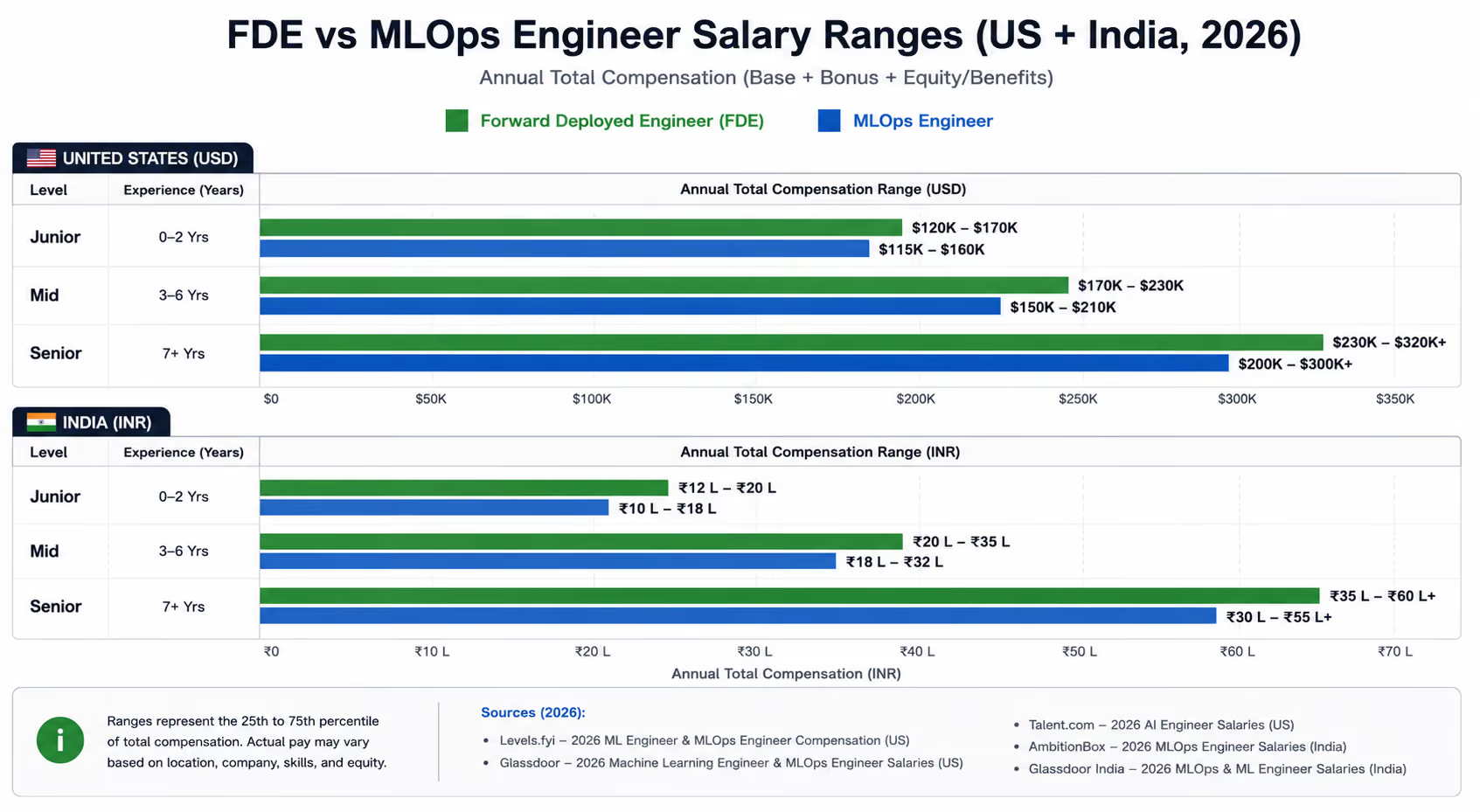
Both roles pay well above the software engineering median. The FDE compensation premium reflects the scope of ownership — accountability for a customer's AI outcomes, not just a technical layer.
In the United States:
FDE compensation at Palantir, OpenAI, and Anthropic typically includes meaningful equity, elevating total compensation significantly above base. According to ZipRecruiter, the average annual US salary for an MLOps engineer is approximately $87,000–$137,000; Glassdoor puts ML engineer base salaries around $156,000 for senior-level roles.
In India:
MLOps engineers at established tech firms earn roughly ₹12–30L, with top-tier companies pushing toward ₹35–40L at senior levels. FDE roles in India are newer as an explicit category — but global remote FDE positions accessible to Indian engineers (a growing segment FDE Academy graduates target) have ranged from ₹25–60L+ equivalent in total compensation.
See the full FDE salary data for a tier-by-tier analysis across regions and company types.
Both are growing. The comparison is lopsided in FDE's favor.
MLOps has been on a steady structural upward curve as more companies move ML into production. The World Economic Forum has projected 40% growth in demand for ML operations roles. The discipline is maturing and spawning sub-specializations — feature store engineering, model monitoring, ML platform engineering.
FDE is growing from a much lower base and at a dramatically higher rate. Forward Deployed Engineer job postings grew 800%+ between 2024 and 2025, per Futurense's hiring market analysis. The role is transitioning from Palantir-specific jargon to an industry-wide recognized category. OpenAI, Anthropic, Scale AI, Cohere, Writer, and hundreds of enterprise AI companies now hire FDEs explicitly.
The comparison in concrete terms:
Yes — and it's one of the more natural transitions available in AI in 2026.
MLOps engineers already understand how production ML systems behave, what breaks in deployment, and why the gap between a notebook model and a live production system is often enormous. That fluency is genuinely rare and valuable in an FDE context. Most engineers entering FDE roles don't have it — MLOps professionals do.
What MLOps engineers typically need to develop for the transition:
FDE Academy's cohort includes engineers who have made exactly this transition. The structured 8-month PGP is designed to close the gap systematically — not just on technical skills, but on the customer-facing and business-outcome dimensions that MLOps experience alone doesn't build.
For the step-by-step path, how to become a Forward Deployed Engineer walks through the specific experience signals hiring teams look for. How FDEs compare to software engineers gives additional scope on what the role demands beyond technical depth.
The decision comes down to where you want to own outcomes and what environment you thrive in.
Choose MLOps engineering if:
Choose FDE if:
The compensation premium for FDE reflects the scope of that ownership. So does the difficulty — and the visibility it creates within any organization.
FDE Academy is the only structured 8-month program built specifically for the Forward Deployed Engineering career path — designed by practicing FDEs and built on the Discover → Prototype → Validate → Ship → Iterate methodology that defines the role. With 60 selective seats per cohort, an optional IIT Roorkee certification extension, and a curriculum built by senior FDEs and AI leaders from companies including Palantir, OpenAI, and Anthropic, it's built for engineers serious about making the transition. See the full program at fde.academy.
A Forward Deployed Engineer deploys AI systems inside a customer's real environment and owns the business outcome of that deployment end-to-end. An MLOps engineer builds and maintains the internal infrastructure — pipelines, monitoring, feature stores — that ML teams use to develop and ship models. FDE is externally focused and business-outcome-driven; MLOps is internally focused and infrastructure-driven. Both touch production AI, but from fundamentally different directions.
The foundation overlaps significantly. Both need Python, cloud infrastructure, Docker/Kubernetes, and a strong understanding of how ML models behave in production. The divergence is at the application layer: MLOps engineers go deep on orchestration tooling, CI/CD pipelines, and model monitoring platforms. FDEs go broader, combining solid engineering with customer communication, business problem framing, and end-to-end deployment ownership. FDE requires breadth; MLOps rewards depth.
FDE roles generally command a higher compensation ceiling. In the US, experienced FDEs at AI-first companies like Palantir, OpenAI, and Anthropic typically earn $160,000–$300,000+ in total compensation at mid-to-senior levels. Senior MLOps engineers with 5+ years of experience typically earn $140,000–$200,000 in base salary, per Glassdoor and ZipRecruiter data. The FDE premium reflects broader ownership — accountability for customer outcomes, not just technical components.
Yes, and it's one of the more natural transitions in AI. MLOps engineers already have strong production ML fluency — they understand how systems break in deployment and how to debug infrastructure in live environments. That knowledge is genuinely rare. The transition gap is usually on the customer-facing side: learning to run discovery sessions, frame business problems, and own outcomes across the full deployment lifecycle. These skills are learnable with structured practice.
Both are mid-to-senior roles that require demonstrated production experience. MLOps has more total job openings and more established hiring pipelines — the discipline is mature. FDE is newer as an explicit job category, which means hiring criteria are less standardized and the supply of trained candidates is very low relative to demand. For qualified candidates who can credibly position for FDE roles, the role-to-candidate ratio is significantly more favorable than in MLOps.
Yes — at a working-knowledge level. FDEs need to work fluently within ML infrastructure environments, debug pipeline issues, and communicate meaningfully with MLOps teams at customer organizations. They don't need to own or build MLOps platforms. Think of it as informed consumption, not deep specialization. An FDE who can't speak MLOps fluently will struggle in enterprise AI environments.
The world is hiring - and this Academy prepares you for it.